
Spotted lanternfly egg masses are how this insect gets through a New Jersey winter. The adults you watched all September die with the cold. The eggs do not: they sit under a gray, mud-like coating on bark, stone, fences, and anything else left outdoors, and they hatch the following May. The first hard frost ends the swarm you can see and leaves next year’s in place.
TL;DR
Spotted lanternfly egg masses are the only stage of the insect that lives through a New Jersey winter. The New Jersey Department of Agriculture says adults do not survive the winter and the egg masses do, that each mass holds 30 to 50 eggs, and that masses can be seen from September to June. Rutgers Cooperative Extension puts the hatch around mid-May. Eggs are laid on tree bark, rocks, fence posts, outdoor furniture, firewood, and vehicles, and most of the masses on a tree sit higher than a person can reach. Scraping the ones within reach into rubbing alcohol or hand sanitizer works better than any egg-killing spray tested so far, according to the state. Every New Jersey county is under quarantine, so residents in Essex County towns such as Short Hills, Millburn and Montclair are asked to check outdoor items before moving them.
The New Jersey Calendar, From the Last Adult to the First Nymph
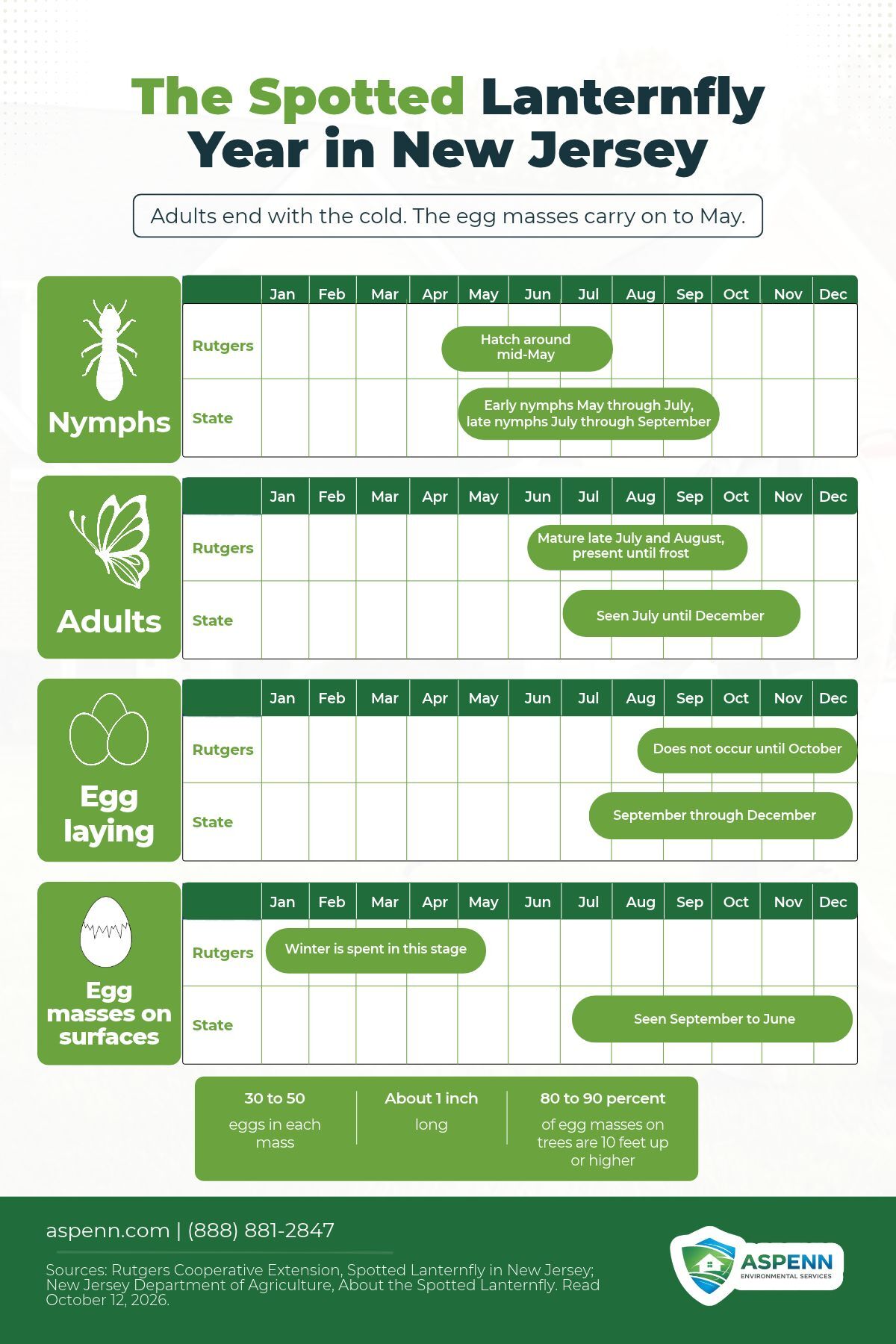
Two New Jersey sources publish dates for this insect, and they do not match line for line. We put them side by side because the gap between them is useful: it tells you the egg-laying window is wider than one month.
The Rutgers Cooperative Extension page on spotted lanternfly in New Jersey says adults are present until frost, that mating is delayed, and that egg-laying does not occur until October. The state agriculture department’s life stage page opens the window a month earlier and keeps it open through December.
| Life stage | Rutgers Cooperative Extension | New Jersey Department of Agriculture |
|---|---|---|
| Early nymphs, black with white spots | Hatch around mid-May | May through July |
| Late nymphs, red with black and white | Not dated | July through September |
| Adults | Mature in late July and August, present until frost | Seen from July until December |
| Egg laying | Does not occur until October | Starts in September, runs through December |
| Egg masses on surfaces | The insect spends the winter in this stage | Can be seen from September to June |
Penn State Extension squares the two. The extension’s egg mass article says laying runs from late summer into early winter, with most of it happening in October.
What that means in a yard in Montclair or Millburn is simple. A mass you find in the last week of September is not early, and a female still laying on a mild day in November is not late. The one date nobody disputes is the far end: nymphs come out in May.
Where Do Spotted Lanternflies Lay Their Egg Masses?
Spotted lanternflies lay egg masses on almost any flat or smooth outdoor surface, and trees are only part of the list. The New Jersey Department of Agriculture’s page about the spotted lanternfly and its life stages names tree bark, rocks, lawn furniture, firewood, boats, RVs, pallets, “or anything left outdoors”. The department’s homeowner page adds fence posts.
The same state page carries the number that changes how you search. It reports research showing that 80 to 90 percent of the egg masses on a tree are found 10 feet or more above the ground. Whatever you can see from the lawn is the small share.
Start with the trees the adults were on
Late-season adults lay close to where they feed. The state page says late adults tend to prefer trees other than tree-of-heaven and names silver maple and willow. Black walnut, red maple, river birch, and willow are on the Rutgers list of key hosts, and those trunks get the first look.
Females favor protected spots, according to Penn State Extension: the underside of a limb, the underside of a picnic table, any surface that is horizontal or angled toward the ground. They also lay next to existing masses. One mass on a fence post usually means more on the same post.
Tree-of-heaven still deserves a look. The state calls it the preferred host and recommends removing it where that is possible and practical, using an herbicide. If one grows on your lot line, check its trunk and the trees beside it.
Then check everything that does not have bark
This is the part people skip. On our own Short Hills page we describe egg masses sticking to a car roof, a landscaper’s trailer, a delivery pallet or a piece of stored patio furniture, carried in along the Route 24 and JFK Parkway corridor. Those same objects are where to look.
A walk around the property should cover:
- The underside of benches, picnic tables and other outdoor furniture
- Fence posts and rails
- Rocks, stone, bricks and deck boards
- The grill, the firewood stack and anything else stored outdoors
- Trailers, mowers and vehicles that sit outside, including the wheel wells
Fresh, Weathered or Already Hatched: Reading the Mass in Front of You
An egg mass is about an inch long, and what it looks like depends on its age. Only two of the three states below hold live eggs.
| What you see | What it is | Live eggs inside? |
|---|---|---|
| A light gray smear that looks like wet or freshly dried mud | A newly laid mass with its coating intact | Yes |
| A light tan patch, dry and cracked like old mud | An older mass that has weathered | Yes, until it hatches |
| Rows of small seed-like eggs with no coating, each with an oval hole at the top | A hatched mass | No |
The first two descriptions come from the state agriculture department. The oval holes are Penn State’s detail: each egg has a small hatch door at the top, and once those are open, the nymphs have already left.
That matters in October. Old egg cases laid up to two years ago can still be found on trees and structures, the same article notes, and some of what you find on a trunk this fall is last year’s empty shell.
Does a New Jersey Winter Kill Spotted Lanternfly Eggs?
No. A New Jersey winter kills the adult spotted lanternflies and leaves the egg masses alive. The state agriculture department says it in one line: the adult does not survive the winter, and the egg masses do. The Rutgers page agrees: the insect spends the winter as an egg mass and hatches around mid-May.
This is the opposite of what happens with wasps. A yellowjacket colony is finished by the freeze and never comes back to the same nest, which is why we wrote that a wasp nest found in fall can often be left alone. Lanternfly runs the other way. The cold removes the generation you can see and does nothing to the one stuck to your maple.
We looked for a temperature that kills the eggs and did not find one on the Rutgers page or either state page. None of them tells homeowners to count on a cold snap. Until a New Jersey source publishes that figure, we treat every coated mass as one that will hatch.
Two details explain the staying power:
- The coating the female lays over the eggs is believed to help them survive winter conditions and predators, according to Penn State. Masses that never got a coating have a 10 percent lower hatch rate on average, and they can still hatch.
- A female can lay up to two masses, per the state.
Scraping: What It Does and What It Cannot Reach
Scraping is the most effective thing you can do to a mass you can reach. It is also limited by height, and the sources are frank about that.
Penn State Extension’s article on what to do with spotted lanternfly egg masses, updated June 1, 2026, measured maples 30 to 40 feet tall and found that fewer than 2 percent of the masses were within 10 feet of the ground. New Jersey’s figure for trees in general is that 80 to 90 percent sit above that line. The two numbers differ and point the same way.
Scrape anyway, and be honest about the arithmetic. Each mass you destroy can take up to 50 insects out of next year’s generation. The Penn State article’s own wording is that scraping may reduce the nymphs and adults you see later and will most likely not eliminate the population from your area.
There is a second reason to do it. Because the insect winters as an egg mass, the Rutgers page warns, it is very likely to be carried to a new location by accident. A mass scraped off a trailer in October is one that does not travel.
How to scrape a mass so it stays dead
- Use a plastic card or a putty knife.
- Scrape into a bag or container holding rubbing alcohol or hand sanitizer. Soapy water is the alternative Rutgers gives.
- Leave the eggs in the solution permanently, seal it, and put it in the trash.
- Do not let scrapings fall to the ground. Eggs scraped onto the soil can still hatch.
- Smashing works too, but only with firm, even pressure across the whole mass.
Stay off ladders. The extension article says plainly that it does not recommend ladders or climbing to reach high masses, and we agree. A fall from a maple is a worse outcome than a few hundred nymphs.
What the Oil Trials Found, and What We Will Not Promise
Spraying egg masses with oil has been tested, and it works partway. The state agriculture department’s homeowner resources for spotted lanternfly summarize trials run in 2018 and 2019 on intact, coated egg masses between February and April.
| Trial detail | What the state page reports |
|---|---|
| Most effective products tested | Paraffinic and mineral oils, the kind used on fruit crops |
| Strength needed | A solution of at least 3 percent |
| Result | Up to 75 percent of treated eggs killed |
| Plant-based option | Soybean oil gave similar control at a 50 percent concentration |
| Condition | Good coverage, applied directly to the egg masses |
Two cautions sit beside those results. The page states that for masses within reach, smashing or scraping works better than any ovicide currently available. It also notes that some trees are sensitive to horticultural spray oil, so the label decides where it can go.
Here is where we have to be careful about our own services. Our dormant application uses horticultural oils, and its page lists the pests it is aimed at: adelgids, mites, aphids, scales, caterpillar eggs, and several others. Spotted lanternfly eggs are not on that list.
For that reason, we will not tell you that a visit is a lanternfly egg treatment. The trials above used named oils, a stated strength, and direct coverage of each mass. If egg masses are your concern, ask us about them specifically, and we will tell you what we can do on your trees.
What the Statewide Quarantine Asks of a Homeowner
Every county in New Jersey is under the spotted lanternfly quarantine. The state’s homeowner page reads “All New Jersey counties are now quarantined”, and that includes Essex County. We cite the agriculture department for this because the Rutgers page still describes an eight-county quarantine in its body copy while a headline it links to says all counties.
The permit rules in the quarantine fall on businesses and organizations that move goods and equipment. What it asks of a resident is lighter and still real. The department’s plain-language summary says the general public can move outdoor items after completing a compliance checklist, which records that you inspected them and found no living life stage.
That checklist is why egg masses are the stage that matters most in winter. An adult will jump off a trailer. An egg mass will ride it from Short Hills to a ski house and hatch there in May.
Before anything that lives outdoors leaves your property, the state asks you to look at:
- Vehicles: doors, sides, bumpers, wheel wells, grills and roofs
- Firewood of any species
- Outdoor furniture, grills, tarps and plant containers
- Boats, trailers, campers and mowers
- Bricks, lumber, stone and other building materials stored outside
If you find a mass, the resident checklist says to remove it, destroy it, seal it in a bag and put the bag in the garbage. The state also suggests parking 15 feet away from trees where you can.
Where a Visit From Us Fits
A scraper does nothing about the insects that hatch from the masses you could not reach. That is where our spotted lanternfly control application comes in. Its page lists where the spray goes: shade trees up to 20 feet tall, fence lines, shrubs, under decks, and around pools and patios.
For egg masses themselves, our town pages say what we do, and we will repeat it here without adding to it. On a visit for lanternfly in Short Hills and Millburn, we can survey the grounds, point out the hidden egg masses, and treat the live insects on the same visit. The page for Montclair’s tree-lined streets describes the same approach, with egg mass work added in fall and winter.
Walk the Yard for Egg Masses Before the Leaves Finish Falling
Pick a dry afternoon this month and do one slow lap: the trees the adults crowded in September, then the fence, then everything stored outside. Scrape what you can reach into alcohol, note which trees have masses higher up, and check anything about to leave the property for the winter.
If the count on your trees is more than a scraper can answer, tell us what you found. Aspenn Environmental Services serves Short Hills, Millburn, and Montclair in Essex County, and a note of which trees carry egg masses is the most useful thing you can hand us before spring.