
TL;DR
Mosquito season in New Jersey is worst for disease risk from late July through September, even though biting pressure often feels heaviest in June and July. West Nile virus builds slowly in a cycle between birds and Culex mosquitoes, so infected mosquitoes are uncommon until August. New Jersey Department of Health surveillance recorded its highest count of West Nile-positive mosquito pools in 2025 during the weeks ending July 25 through August 30, and human illness onsets that year ran into the week ending October 25. Yard treatment that stops in early September ends right as the risk curve is cresting. The last six weeks of the season are the ones worth covering.
The Virus Spends the Whole Summer Getting Ready
West Nile does not arrive in a yard the way a swarm of salt marsh mosquitoes does. It grows there, quietly, in a loop that has nothing to do with people.
Rutgers puts the mechanism plainly. Fact sheet FS526 from the Rutgers New Jersey Agricultural Experiment Station, written with the director of the Rutgers Center for Vector Biology, states that the primary amplifiers of the virus are bird species such as American robins and house sparrows, which carry it without getting sick and remain infectious to the mosquitoes that bite them. Each round of bird-to-mosquito-to-bird transmission pushes the infection rate in the local mosquito population a little higher. The same fact sheet states that in the Northeast, infected mosquitoes are rarely found in large numbers until August, and that the virus is at its lowest levels in early spring and builds in intensity as the summer season progresses.
Two other things happen on the same schedule.
Female Culex mosquitoes that survive into August have had a longer feeding career than the ones flying in June, so more of them have taken a blood meal from an infected bird. Delaware’s mosquito control staff describe the same effect in DNREC’s Outdoor Delaware feature on sentinel chicken surveillance: older mosquitoes that have taken multiple blood meals are the ones most likely to be carrying something, and it takes until at least halfway through the summer for that to happen. Then the feeding preference shifts. Rutgers notes that Culex pipiens increases its likelihood of biting mammals in the fall, when an infection cycling between birds starts reaching people and horses.
Bird amplification, older mosquitoes, a late shift toward mammal biting. Those three lines converge in August.
What New Jersey’s 2025 Surveillance Season Actually Showed
The state does not guess at this. County mosquito agencies trap and submit pools of mosquitoes for testing all season, and the New Jersey Department of Health publishes the results.
Its 2025 season summary reported 11,003 mosquito pools tested for West Nile virus and 1,159 of them positive, a pool positivity rate of 10.5 percent and the second most active detection season on record after 2018. The report is specific about timing: the highest number of positive pools was detected between CDC weeks 30 to 35, the weeks ending July 25 through August 30. Culex mosquitoes accounted for 1,028 of the 1,159 positives, about 89 percent.
Human illness followed behind that curve rather than tracking it. The same summary records 23 human West Nile cases in New Jersey in 2025, with one death, 17 of them neuroinvasive, and dates of illness onset running from CDC week 30, the week ending July 26, through CDC week 43, the week ending October 25. Twenty-one of the 23 cases were hospitalized, with an average stay of 15 days.
Read those two windows next to each other, and the argument makes itself. Mosquito infection crests in the back half of the summer, and people get sick from it into the middle of autumn.
| Part of the season | What the 2025 New Jersey data showed |
| May to early July | Testing underway, few positives, biting pressure often at its most annoying |
| Weeks ending July 25 to August 30 | Highest count of West Nile positive mosquito pools all year |
| Week ending July 26 onward | First human illness onset of the year |
| September | Positive pools still circulating, Eastern equine encephalitis activity picking up from the week ending September 20 |
| Through the week ending October 25 | Human illness onsets still being recorded |
Where Does 2026 Stand Right Now?
Ahead of last year, in the mosquitoes. The New Jersey Department of Health’s surveillance report for CDC week 29, covering July 19 to 25 and published from data pulled on July 30, 2026, counted 227 West Nile-positive mosquito pools from eighteen counties out of 4,899 pools tested, and stated flatly that mosquito detections this year are higher than historical averages. No human or animal cases had been reported in New Jersey at that point.
That combination is normal for the calendar, and it is the part homeowners misread. Zero human cases in late July does not mean a quiet year. In 2025, the earliest human case in the state was reported in week 30, which is the week the 2026 report was written.
Our neighbors are on the same clock. Delaware announced its first West Nile detection of 2026 on August 5, in a DNREC release on news.delaware.gov, from a sentinel chicken flock in eastern Kent County sampled July 20 and confirmed July 31. DNREC’s mosquito control administrator said that slightly earlier than the state’s typical first detection, historically the last week in July or the first week of August. Delaware recorded three human cases in 2025, one of them fatal.
Nuisance Season and Risk Season Run on Different Calendars
This is the distinction that gets lost, and it explains why the seasonal service most people buy ends about six weeks too early.
The mosquitoes that ruin a June barbecue in central Jersey are largely container breeders, above all the Asian tiger mosquito, which bites in daylight, stays close to where it hatched, and multiplies fast after a wet stretch. Biting pressure from that group tracks rainfall. The mosquitoes that carry West Nile here are mostly Culex, which prefer stagnant, organically rich water in catch basins, in clogged gutters, and in any neglected container holding leaf soup, and which feed at dusk and after dark. Their numbers can look unremarkable in a backyard at the exact moment their infection rate is at its highest.
So the yard can feel better in September while the actual health risk is higher than it was in June.
Does Mosquito Season End After Labor Day in New Jersey?
No. Activity ends with cold, not with the school calendar. The Office of the New Jersey State Climatologist at Rutgers, in its New Jersey climate overview, puts the average number of freeze-free days at 163 in the northern highlands, 179 across the central and southern interior, and 217 along the seacoast, with the first frost in the Northern Zone arriving around October 7.
Work backward from that. A property in Middlesex or Monmouth County typically has a month and a half of mosquito weather left on Labor Day, and a shore property has closer to two. New Jersey’s Department of Environmental Protection describes mosquitoes here as active throughout the warm weather until hard frost reduces activity in late fall, on the Fish and Wildlife mosquito FAQ at dep.nj.gov.
Warm Septembers stretch it further. A single cool night in the fifties suppresses flight for an evening and changes nothing about the following week.
The practical version: the last treatment of the year should be keyed to the forecast, not to a date somebody picked in March.
Middlesex County Sits Near the Top of the State Map
Our home county is not a bystander in this data, which is worth knowing if you live in East Brunswick, Edison, North Brunswick, or Old Bridge.
Middlesex County recorded, in the state’s 2025 season summary, 108 West Nile-positive mosquito pools, second only to Bergen County’s 214, out of 391 pools submitted from the county. Middlesex also tied for the most human cases of any New Jersey county that year at four, plus two positive viremic blood donors. Bergen, Middlesex, Hudson, and Hunterdon were named as the counties with the highest positive pool counts during the peak weeks.
There is a structural reason for that. This is dense, well-watered suburban ground with an enormous amount of small stagnant water in it: storm drains under every intersection, older neighborhoods with mature tree canopy and clogged gutters, retention basins behind newer developments, and the low ground along Lawrence Brook, Farrington Lake, and the South River. Culex does not need a pond. It needs a bucket of leaf soup, and a township like East Brunswick has thousands of them.
That is also the point where a yard stops being a do-it-yourself problem. Tipping containers handle what you can see. It does not touch the catch basin at the curb, the neighbor’s tarp, or the adult mosquitoes already resting in dense shrub lines along a property edge, which is what a late-season adulticide and larvicide program is for. Our mosquito control East Brunswick homeowners book through October is built around that back half of the season, and the same approach runs on the Edison service and in Mosquito Control in North Brunswick, NJ. County programs handle the public side of it, and the NJDEP Fish and Wildlife mosquito FAQ named earlier lists how to reach your county mosquito control commission for spray mission schedules and complaints.
What Changes on a Property in the Last Six Weeks
Late season work looks different from June work, and the difference is mostly about where water sits and where adults rest.
Gutters move to the top of the list. By late August, a full season of leaf litter, seed pods, and grit has collected in them, and a blocked run holds exactly the warm, organic water Culex prefers. The same goes for corrugated drain extensions, which hold a slug of water at every low point.
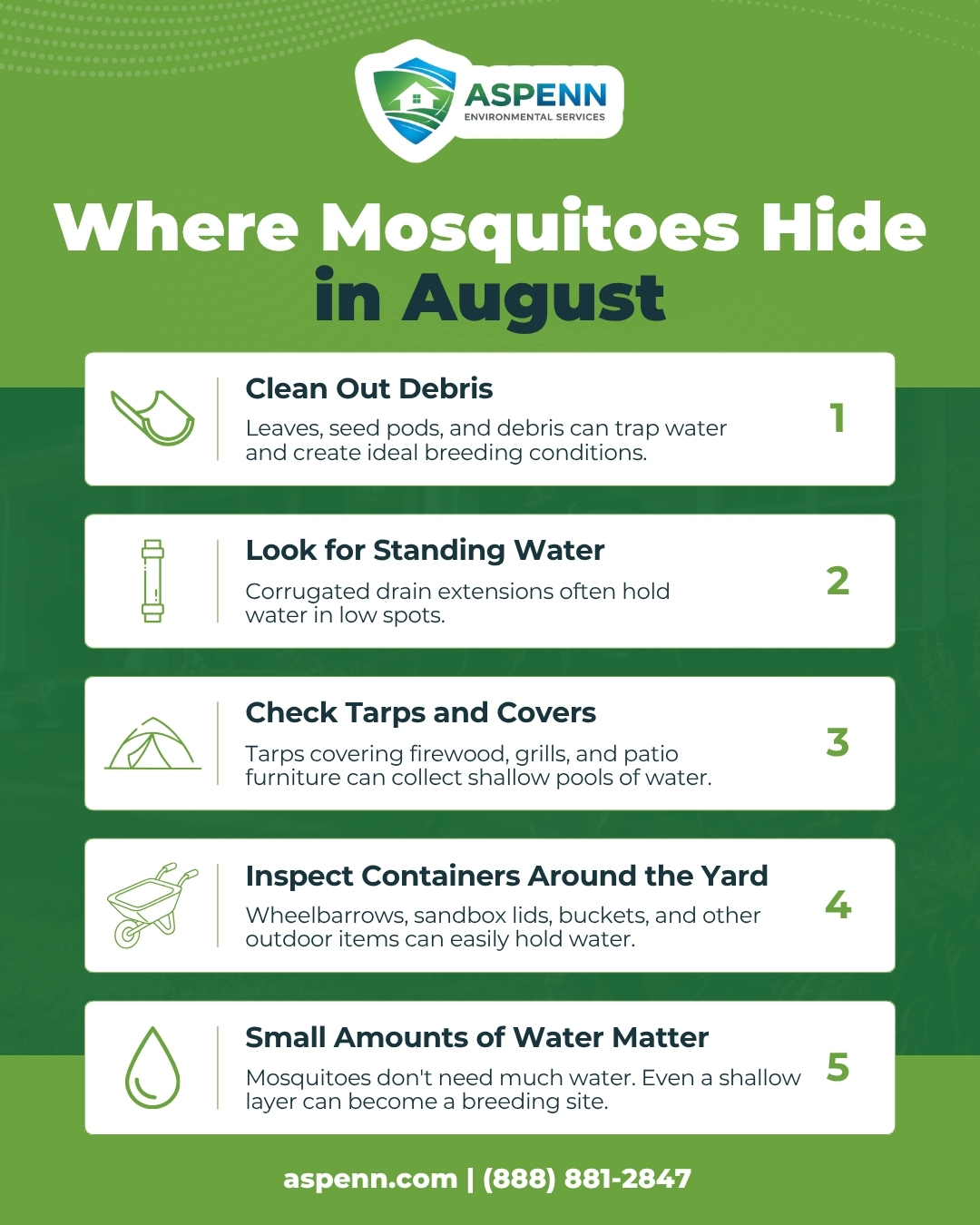
Then the forgotten containers. A film of water a quarter of an inch deep is enough, so walk the property and turn over:
- Tarps over firewood and patio furniture
- Wheelbarrows and kids’ sandbox lids
- Saucers under potted plants
- The bottom of a recycling bin
- The rim of a boat cover
Catch basins and low ground are the pieces a homeowner cannot reach, and they are where a treatment program earns its keep. Larvicide in standing water that cannot be drained, targeted adulticide on the shaded resting sites along fence lines and under decks, and a visit schedule that keeps running while the weather does.
Two habits matter more than any product in September. Change birdbath water twice a week rather than once, because Culex development is fast in warm water. And run outdoor time earlier: dusk through mid-evening is when the Culex species that carry West Nile are actively feeding, which is a different pattern from the daytime biting people associate with tiger mosquitoes.
If you also walk a wooded edge on your property, remember that the tick calendar is running underneath all of this and adult deer ticks are coming into their fall activity at the same time.
Delaware, Maryland, and the Rest of Our Footprint
The same seasonal shape applies across the region we cover, with local wrinkles. Coastal Delaware and the Maryland shore carry a salt marsh brood problem on top of the Culex cycle, and those broods arrive on the tide rather than on the rain, which we walk through in our piece on why Delaware beach yards get swarmed overnight. Inland properties in Pennsylvania and New York behave much like central New Jersey.
What does not change is the timing of the disease curve. Bird amplification, aging mosquito populations, and a fall shift toward mammal biting are regional biology, not a New Jersey quirk.
Locking In the Late Season Before First Frost
If your mosquito service is scheduled to stop in early September, move the end date. The state’s own numbers put peak mosquito infection in the weeks ending late July through August and human illness onsets running into late October, which means the coverage most homeowners buy expires during the riskiest stretch of the year. Adding two or three visits through the fall costs less than a full season and covers the part of the season that actually carries West Nile.
We treat properties across New Jersey and eight other Northeast states, and we push September and October bookings the hardest for the reasons above. Aspenn Environmental Services can extend an existing plan or start a late-season program on a property that has never had one. Take a look at how our New Jersey service is set up or at the mosquito treatment itself, then pick a start week off the forecast rather than the calendar.