
A wasp nest found in a New Jersey fall has a built-in end date. Every yellowjacket, paper wasp, and hornet colony here is annual: the workers and the old queen die as the cold settles in, the nest is abandoned, and it is never used again. So the real question is not how to get rid of it. It is whether this particular nest, in this particular spot, can be left alone for the few weeks until the first hard freeze reaches your town.
TL;DR
A wasp nest in fall in New Jersey dies on its own once hard freezes arrive, and Rutgers Cooperative Extension states that hornets, yellowjackets, and paper wasps abandon their nests in the fall and do not reuse them. Leave a nest that is high in a tree, away from paths, or in a corner nobody uses. Deal with it now if it is in a mowed lawn, beside a door, inside a wall, or near anyone allergic to stings. In central New Jersey, the median first 28-degree night falls in early November, according to NOAA climate normals, so a nest you find in late September has several active weeks left. Never seal a wall entrance with the wasps inside, and plan next season’s coverage for spring, when new queens start building.
Will a Wasp Nest Die on Its Own Once It Gets Cold?
Yes. A wasp nest in a New Jersey fall is on its last run. The Rutgers fact sheet on hornets, yellow jackets and paper wasps from Rutgers Cooperative Extension says all three abandon their nests in the fall, that the old nests are not reused, and that the species carries on only through queens that hibernate over winter.
That last point is the whole biology of it. The colony you are looking at was started by one queen in late spring. It spent the summer growing, and now it is raising the males and new queens that will leave, mate, and hide for the winter. Everything else in that nest, including the queen who built it, has no future past the cold.
What the fact sheet does not do is give a date, and that matters. Cold ends the colony, but a single chilly night in October does not. The wasps are still flying on warm afternoons until a real freeze knocks the colony down.
| What happens in fall | What it means for you |
|---|---|
| Workers and the founding queen die | The nest stops being a problem on its own |
| New queens leave to overwinter elsewhere | Next year’s nests start from scratch, somewhere new |
| The paper nest is abandoned | It falls apart or gets torn up by birds and squirrels |
| The nest is never reused | Removing an empty nest in December prevents nothing |
Where the Nest Sits Decides Everything
The location of the nest, not the species, is what tells you whether to wait. Penn State Extension’s eastern yellowjacket fact sheet is blunt about it: unless a nest is close to a building entrance, in a lawn that gets mowed, or somewhere people are likely to run into it, the nest can be ignored.
The same sheet adds two exceptions that override location. Anyone with a known sensitivity to wasp and bee stings should have nests close to the house removed by a pest control company. And any nest inside the walls or attic should be treated by a licensed company, because of how hard that treatment is to do well.
Nests you can usually leave for the cold
- A gray paper ball high in a tree at the back of the lot, well above head height
- A small open comb under the eave of a shed nobody goes into
- A ground entrance in the wooded strip behind the fence, away from where anyone walks
- Anything you only noticed because the leaves came down
Nests that should not wait
- A ground entrance in turf that still has three or four mowings left this season
- Anything within a few steps of a door, a deck stair, a mailbox, or the garbage cans
- An entrance hole in siding, a soffit, a foundation crack, or a gap around a vent, which usually means a nest inside the wall
- Any nest on a property where someone has reacted badly to a sting before
The Rutgers sheet draws the same line from the other side. It says nests built too close to the house, or in bushes where children play, should be destroyed, and that a stung person with a history of allergic reactions should have a physician notified right away.
Ground nests are the ones that catch people out in fall. A yellowjacket colony dug into a lawn in East Brunswick or North Brunswick is easy to miss until someone runs a mower over the entrance.
When Does the Cold Actually Arrive in Our Part of New Jersey?
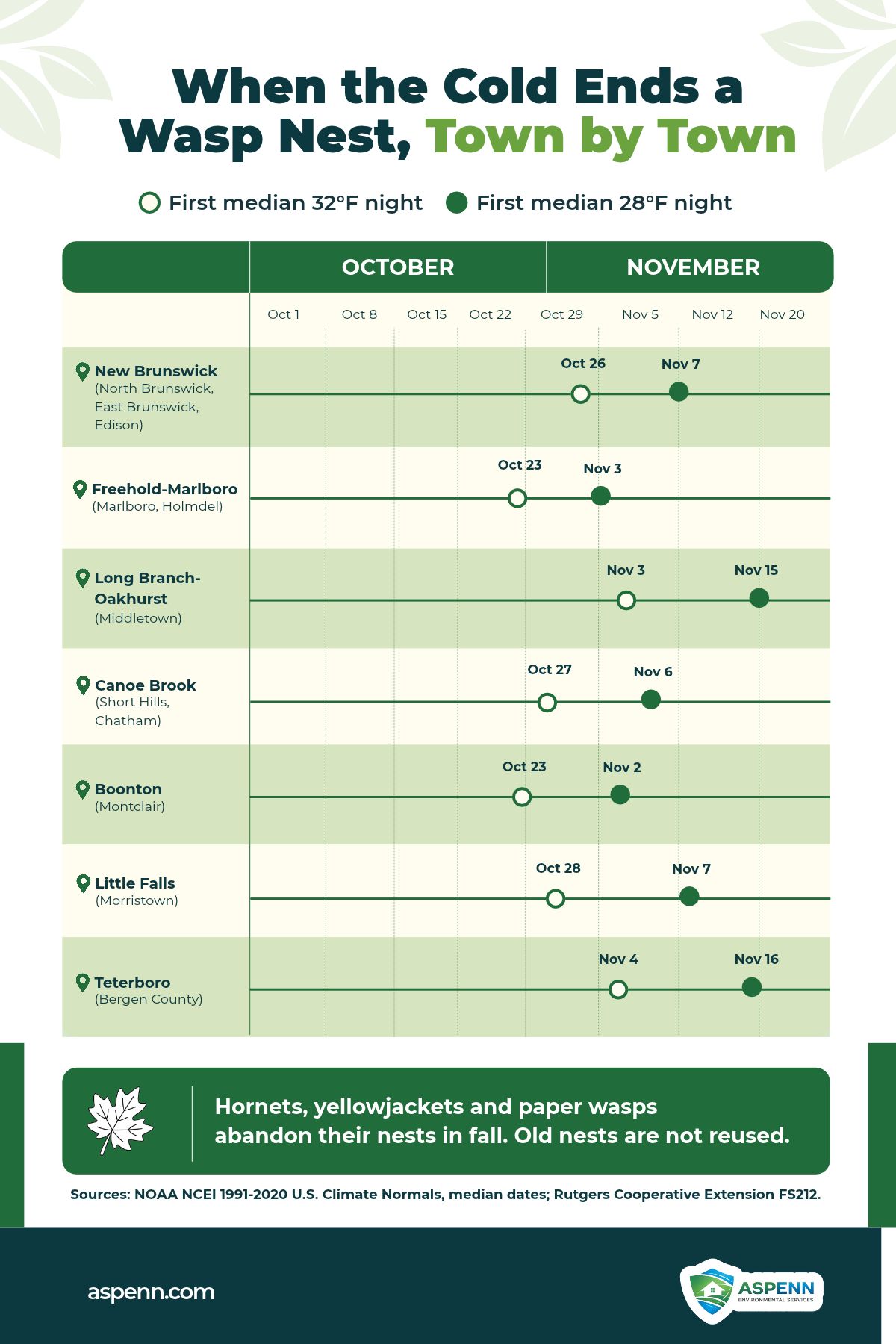
Later than most people expect. At the New Brunswick station, the median date of the first freezing night is October 26, and the median date of the first 28-degree night is November 7, based on NOAA’s 1991 to 2020 U.S. Climate Normals from the National Centers for Environmental Information. A nest found in the last week of September in Middlesex County has, in a typical year, around six weeks of life ahead of it.
We use the 28-degree column as the practical marker, because a light frost on the lawn is not the same as a night cold enough to finish a colony. Penn State’s European hornet fact sheet makes the same distinction in its own advice, which is to wait for the first hard frost or two.
| NOAA station | Towns we serve nearby | Median first 32 F night | Median first 28 F night | 32 F by this date, 1 year in 10 |
|---|---|---|---|---|
| New Brunswick 3 SE | North Brunswick, East Brunswick, Edison | Oct 26 | Nov 7 | Oct 11 |
| Freehold-Marlboro | Marlboro, Holmdel | Oct 23 | Nov 3 | Oct 9 |
| Long Branch-Oakhurst | Middletown | Nov 3 | Nov 15 | Oct 21 |
| Canoe Brook | Short Hills, Chatham | Oct 27 | Nov 6 | Oct 11 |
| Boonton 1 SE | Morristown | Oct 23 | Nov 2 | Oct 8 |
| Little Falls | Montclair | Oct 28 | Nov 7 | Oct 13 |
| Teterboro Airport | Ridgewood, Franklin Lakes | Nov 4 | Nov 16 | Oct 21 |
Two things stand out in that table.
The Monmouth County coast runs late. The Long Branch-Oakhurst station, the closest one to Middletown with published freeze normals, does not see its median first freeze until November 3. A bayshore yard can have active yellowjackets for a week or two after a yard in Marlboro, farther inland, has gone quiet.
To read the table for your own yard:
- Find the station nearest you, and treat its 28 F date as the day the colony is likely finished.
- Check the last column. In one year out of ten, the first freeze comes that early or earlier.
- Count the weeks from today. If the nest is in a spot from the “should not wait” list, several weeks of warm afternoons is too long.
- Keep an eye on the forecast rather than the calendar. The normals describe thirty years, not this one.
The Bergen County number needs care. Teterboro is an airport station in the Meadowlands, and it is the nearest Bergen station with freeze normals published. We would not count on its November dates in Ridgewood or Franklin Lakes, which sit farther north and away from that low ground.
Why Late September Feels Worse Than July
Because it is. The guide to common social bees and wasps from Penn State Extension says bees and wasps typically become more defensive later in summer and into fall, when local food runs short, and that the colony’s rate of reproduction declines at the same time.
Colonies are also at their biggest. The European hornet sheet puts that species’ nest size at its peak in mid-September, usually 200 to 400 workers, and notes that an eastern yellowjacket nest can hold 3,000 to 5,000 individuals at peak size. A nest that was a nuisance in July is a crowd by the time school is back.
European hornets add one more fall habit. The hornet sheet records them as the only nocturnal wasp in its region, drawn to porch lights at night, and says they take more sugar in the fall, which brings them to fallen apples and pears. If big brown and yellow wasps are hitting a back door light in Holmdel or Montclair after dark, a sweet tooth and a light bulb are the likely reasons.
Paper wasps run on a slightly earlier clock. The same social wasps guide says they stop reproducing in late summer, and that by the end of September few, if any, remain. So a thin, open comb under an eave in October is often already empty.
Three Things Never to Do to a Fall Nest
These come straight from the extension guidance, and each one tends to turn a nuisance into an emergency.
- Do not plug or caulk the entrance of a nest in a wall. Both Penn State sheets warn about it. Trapped yellowjackets can chew through interior sheetrock and come out inside the house, and the European hornet sheet says the same of hornets in a wall void.
- Keep gasoline out of a ground nest entirely. The social wasps guide states plainly that gasoline is neither an approved nor a safe method, and that it is a hazard to the environment and to the person pouring it.
- Leave the outside of a nest alone in daylight. The eastern yellowjacket sheet describes what happens when someone stands back and treats only the outside of an entrance: it angers the colony and raises the risk of stings over the next several days.
If a nest is in one of the spots that cannot wait, that is the point at which a licensed applicator earns the call. In New Jersey, the gap between a colony that is dealt with and one that is merely stirred up tends to show up on the next warm afternoon.
What the Empty Nest Means for Next Year
Very little, and that surprises people. Because the nest is never reused, a big paper nest still hanging in a maple in Short Hills in December is just a shell. The European hornet sheet goes further: a nest in a specific tree does not mean one will be built there again the following year.
What does carry over is the queens. The eastern yellowjacket sheet says fertilized queens spend winter under the bark of dead trees and logs and in leaf litter, and the European hornet sheet adds wall voids of buildings to that list. That is the same late-season shift toward shelter we covered in what comes indoors in New Jersey when the nights turn cold, just with a stinger attached.
There is one piece of winter homework worth doing. The social wasps guide suggests marking the entrances you see in summer and fall, then sealing them in winter or early spring once the insects are no longer active.
- Mark the hole in the siding or soffit with tape now, from a safe distance
- Wait for two or three hard freezes and a stretch of cold weather
- Seal it before spring, when queens start looking for sites again
- Leave ground entrances alone; the soil takes care of itself
Is It a Yellowjacket, a Paper Wasp or a Hornet?
It helps to know, because the three nest in different places and fail in different ways. The Rutgers fact sheet sorts them by where they build.
| Insect | Where it usually nests | What the nest looks like |
|---|---|---|
| Yellowjacket | Usually in the ground, sometimes above ground | Football-shaped paper nest, hidden below the surface |
| Hornet | Trees, shrubs, and eaves | Football-shaped paper nest, often gray and hanging |
| Paper wasp | Trees, shrubs, and eaves | Open, honeycomb-like paper comb, no outer shell |
| Mud dauber | Under eaves, porch roofs, behind shutters | Mud or clay cells, never in trees |
Mud daubers and cicada killers, Rutgers adds, usually will not sting unless handled or caught in clothing.
Before Next Spring’s Wasp Queens Start Building
The nest you found this fall will be gone by Thanksgiving in most of our towns. The ones that matter next year have not been started yet. Penn State’s eastern yellowjacket sheet says overwintered queens begin nest building in May or early June, depending on spring temperatures, which is when outdoor coverage does the most good.
Our seasonal pest control program targets wasps among the insects in lawns, shrubs, and ornamental trees, and it runs through the season rather than as a single visit. For homeowners in Middletown, East Brunswick, and the rest of Middlesex and Monmouth County, the town pages for our East Brunswick coverage, pest pressure across Middletown, and what we see on wooded Holmdel lots set out what each area deals with. When you are ready to line up next year, Aspenn Environmental Services prices your property online.