
The thing that makes Montclair beautiful is the thing that makes it a lanternfly town: trees, everywhere. A continuous street canopy, mature yard maples, the old plantings along the avenues, all of it is a buffet for this pest. We are Aspenn Environmental Services, and our lanternfly work stays on the trees and trunks where the insects actually cluster. They are harmless to people and pets, but a heavy population bleeds a tree of sap all season and leaves the deck and the cars below it slick with honeydew.
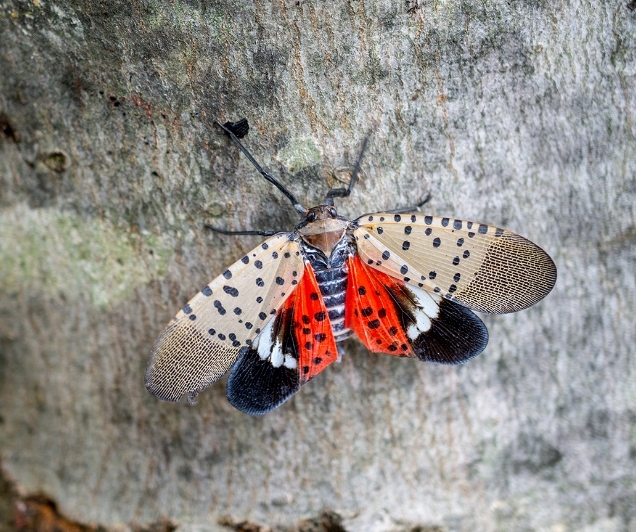
On its own the insect barely flies; it gets everywhere by catching a ride. Egg masses stick to flat surfaces, a car roof, a trailer, a delivery pallet, a piece of yard furniture, and the busy avenues and the rail line keep that traffic flowing through town. Once it arrives, it wants a host, and it starts on tree-of-heaven, the aggressive weed tree that seizes rail sidings and neglected back edges. From there it climbs into the street and yard trees a leafy town is full of.
What sets Montclair apart is that the trees nearly touch. A spread-out suburb gives the pest isolated targets it has to reach; Montclair gives it a bridge, one canopy running the length of a block, so an infestation walks tree to tree and swells quickly once it takes hold on a shaded street. That is why counts here can feel heavier than the same numbers would in an open town.
Lanternfly does not punch holes or strip leaves; it drains. Nymphs and adults tap the bark and siphon sap, and a crowd on a single tree saps it across the season and sends it into winter weaker and more vulnerable. The trees that suffer first are the young ones, the fruit trees, and any already under strain, which on Montclair’s veteran streets can mean the old shade trees a whole block is organized around.
Then comes the honeydew, and that is usually the trigger for the call. Feeding insects drip a constant sugar rain onto everything beneath them, and on a canopied Montclair street that means the sidewalk, the parked cars, the porch furniture, and the low plantings all go sticky and then black with sooty mold, which in turn draws wasps and ants. Both the tired trees and the sticky mess ease off together once we pull the feeding numbers down, because they run on the same cause.

Every one of New Jersey’s 21 counties, Essex among them, sits inside the spotted lanternfly quarantine, so the whole state is in this and Montclair with it. For a homeowner the quarantine really amounts to one habit: give firewood, plants, patio furniture, trailers, and vehicles a look for egg masses and stowaway adults before they leave the property, so your street is not the one seeding the next.
The rest is on your own trees. Drop the feeders and scrape the egg masses off trunks and furniture before winter, and you spare your trees while slowing the crawl down your block. We can survey the property, show you the hidden egg masses, and treat the live insects on the same trip.
Three decades-plus of Northeast pest work, over 2,400 five-star reviews, and BBB accreditation back the service, and we roll lanternfly into the same seasonal plan that handles a Montclair lot for mosquitoes and ticks. We read the trees actually on your street and the stage the insects have reached, then treat to that, rather than spraying every address on one calendar date.
The canopy that pulls lanternfly in is the same canopy that shades the resting spots Montclair’s mosquitoes hide in, so plenty of neighbors take both at once. Start from the full Montclair pest control plan, or pair this with tick control in Montclair.

Lanternfly wears a different look at each stage, and we treat to whichever one is on your trees: black-and-white speckled nymphs early, red-blotched larger nymphs at midsummer, the gray spotted adults from late summer into autumn, and the gray putty-like egg masses laid on bark and hard surfaces before the cold. We knock back the feeding nymphs and adults through the warm season and mark egg masses so the following year opens smaller. Two years of that usually breaks the cycle.
The plan is six seasonal applications, 79 to 99 dollars a month by property size, under the Aspenn Protection Assurance: they surge back between visits and we return to re-treat at no added cost.
Point us to the trees they are swarming and we will match the treatment to their stage.
No, it neither bites nor stings and carries nothing dangerous to people or animals. The cost lands on your trees and your outdoor space, since the honeydew it drops turns sidewalks, decks, furniture, and cars black with sooty mold.
Montclair’s canopy nearly connects, giving the insect a tree-to-tree bridge, so once it settles on a leafy block it multiplies fast. Traffic on the avenues and the rail line keeps refreshing the supply, and tree-of-heaven along the edges fuels it.
Tree-of-heaven leads, then maples, willows, birches, fruit trees, and ornamentals. Young or stressed trees take the worst of the sap loss, which on a mature Montclair street can be the old shade trees the block depends on.
Across the feeding season, spring through fall, set to whether nymphs or adults are on your trees, with egg-mass work added in fall and winter. Two seasons of treatment tend to give the cleanest result.
Sooty mold on honeydew, the sugar the feeders excrete. On a canopied street it films the parked cars, the walks, and the lower plants, and it lifts once the feeding population drops.
Possibly, but not solo and not without a plan, since cutting it wrong triggers aggressive resprouting and a few treated ones can serve as trap trees. We will assess what you have and steer it.
Yes, under the Aspenn Protection Assurance. A hard return between scheduled visits brings us back for a complimentary evaluation and a re-treatment if needed, at no extra charge.
We treat lanternfly across the township, from Upper Montclair and the estate sections to the downtown districts, weighting the mature tree-lined streets where pressure peaks. If your street is not named, just call.