
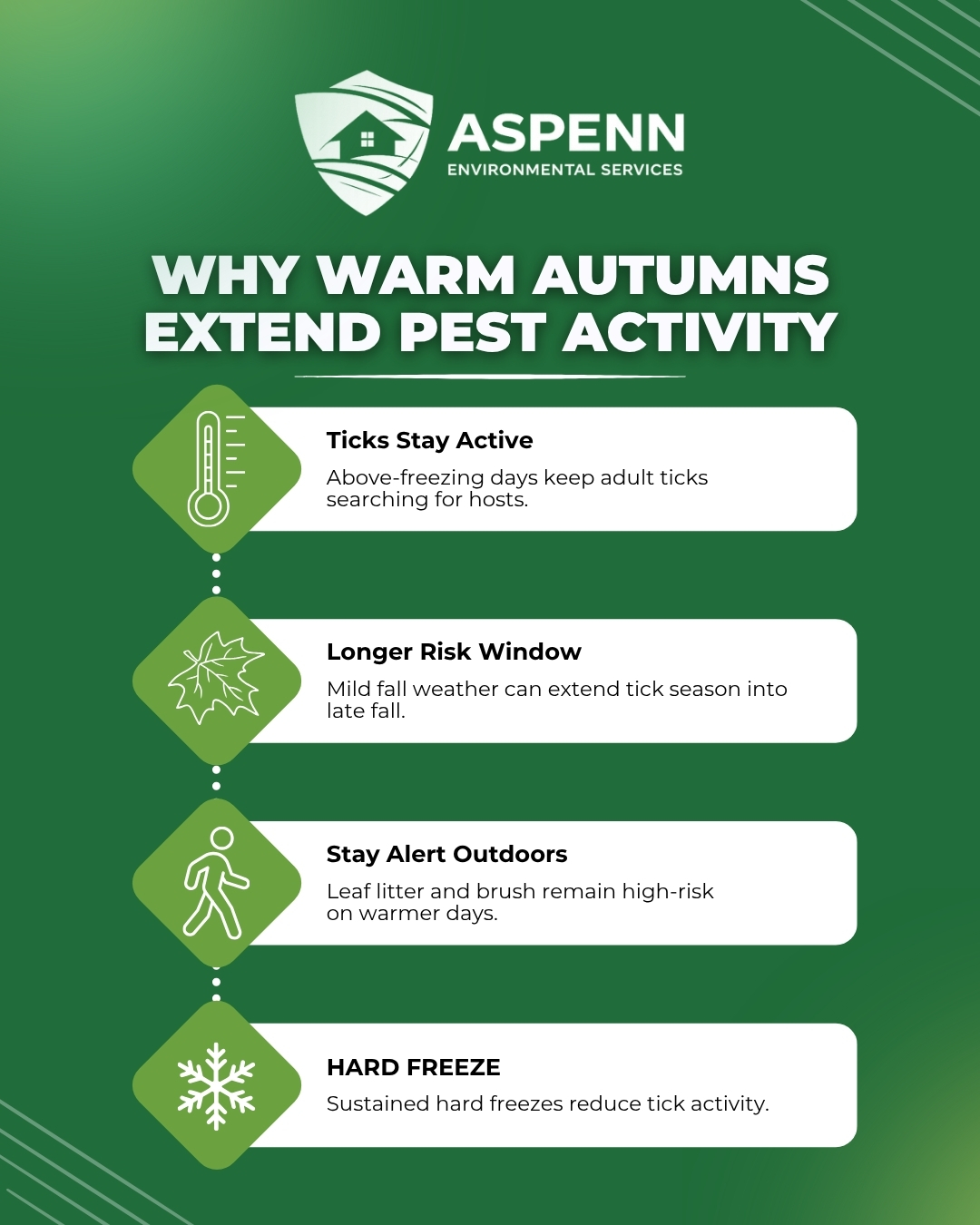
The blacklegged tick, also called the deer tick, is active as an adult from roughly October through May, for as long as daytime temperatures stay above freezing. That means fall is not the end of tick season. It is the start of the adult stage, and adults are the life stage most likely to carry Lyme disease.
Summer is when the tiny nymphs bite, and those cause a lot of infections because they are hard to see. But by September and October, the larger adults are out questing on the tips of grasses and shrubs, waiting for a host. People are still outside raking leaves, hiking, hunting, and walking dogs, with no idea the risk has quietly moved into its second season. Treating the yard and checking for ticks in fall matters as much as it does in July.
What This Guide Covers About Fall Ticks
If you assumed the mosquitoes and ticks were done for the year once the kids went back to school, this is worth five minutes. It also pairs with knowing when mosquito pressure finally winds down, which is later than most people expect.
Below is why the blacklegged tick has two separate active seasons rather than one, what changes when the population shifts from summer nymphs to fall adults, why warm autumn days and mild winters extend the risk further every year, where ticks concentrate on a typical Northeast property in fall, and how to decide whether to keep a tick program running past Labor Day instead of shutting it down out of habit.
Fall Tick Season Is The Adult Deer Tick’s Time
The confusion comes from lumping all ticks and all life stages together. The blacklegged tick has a two-year life cycle with distinct active windows, and the fall one surprises people every year.
According to the University of Rhode Island’s TickEncounter program, a leading authority on Northeast ticks, adult male and female blacklegged ticks are active October through May, as long as the daytime temperature stays above freezing. That is a long window, and it runs directly through the months most people consider tick-free.
The nymphs, the poppyseed-sized immature ticks responsible for most summer Lyme cases, peak from mid-May through mid-July. So the calendar has two humps: nymphs in early summer, adults from fall into spring. The quiet stretch is really late summer, not fall, which is the opposite of what most homeowners assume.
Adults are also the stage most likely to be carrying Borrelia, the bacteria behind Lyme disease, because they have already fed twice in their life and had two chances to pick it up. A fall adult tick is not a lesser threat than a summer nymph. It is easier to spot because it is bigger, and that is the only good news in the comparison.
What Changes When The Population Turns Over
The shift from nymphs to adults changes how ticks behave and where you meet them, which is worth understanding because it changes how you protect a property.
Adults quest higher. Where nymphs wait low in the leaf litter, adult ticks climb to the tips of tall grass, the edges of shrubs and the ends of low branches, roughly knee to waist height, reaching out for a passing deer, dog or person. That puts them right at the level of a pant leg on a fall walk.
They are also tied to deer movement, which picks up in autumn. Deer are the primary host for adult blacklegged ticks and the animal that carries them onto and around a property. As deer become more active through fall, they seed the yard edges with the next generation of ticks, which is why wooded suburban properties with regular deer traffic stay high-risk long after summer ends.
And the activity does not simply stop when the calendar turns to winter. Adults keep questing on any day the temperature climbs above freezing, so a mild December afternoon or a January thaw can put active ticks back on your property when nobody is thinking about them at all. This is the trap of the winter walk: the ground is bare, the air is cold enough that ticks are the last thing on your mind, and one warm afternoon has brought them right back to the trail edge. Hunters and dog walkers, who are out in exactly this weather and exactly this habitat, encounter fall and winter adults more than almost anyone, and are the group most likely to be told “it’s too cold for ticks” while carrying one home.
Why Every Warm Autumn Extends The Risk
The temperature threshold is the key detail, and it is why fall tick season has been stretching longer.
Because adults need only above-freezing days to be active, the length of the fall and winter risk window is set by the weather, not the calendar. A warm, drawn-out autumn keeps ticks questing into November and December. A mild winter with frequent thaws never really shuts them down.
For a family, that means the old mental rule of “ticks are a June thing” is now genuinely unreliable across the Northeast. The safe assumption is that any above-freezing day with someone walking through leaf litter or brush is a day a tick bite can happen. That is not alarmism; it follows directly from when the adults are active.
The practical version is simple. Do not read the first cool morning as the all-clear. The all-clear, such as it is, only really arrives during sustained hard freezes, and even those are interrupted more often than they used to be.
Where Ticks Concentrate On A Fall Property
Ticks are not spread evenly across a yard, and in fall the hot spots shift with the falling leaves. Knowing where they gather tells you where attention is worth spending.
- The lawn-and-woods boundary, where mown grass meets trees or brush, is the single highest-risk zone on most properties
- Leaf litter, which holds the humidity ticks need and piles up exactly when adult season begins
- Stone walls, wood piles and ground-cover beds like pachysandra and ivy, which shelter both ticks and the mice that feed them
- Shaded, damp edges and the borders of trails or garden paths that brush against your legs
- Anywhere deer routinely travel or bed down, since they deliver the ticks
The reason fall raises the stakes is that the season’s chores put people directly into these zones. Raking, clearing beds, stacking wood, and closing up the garden all happen in tick habitat during peak adult activity. Professional tick control focuses on exactly these edges and harborage areas rather than the open lawn, because that is where the ticks actually are.
There is a mouse connection worth understanding here, because it explains why the edges matter so much. White-footed mice are a main reservoir for the Lyme bacteria, and larval and nymphal ticks feed on them before molting into the next stage. Those mice live in the stone walls, wood piles, and ground-cover beds along your property edge, and they are busiest storing food for winter in the fall. So the same autumn borders where adult ticks quest are also where the next generation is being infected. Reducing that harborage, keeping wood stacked away from the house, cutting back dense ground cover, sealing the gaps mice use, does double duty against this year’s adults and next year’s nymphs.
Should You Stop Tick Service After Labor Day?
This is the decision most Northeast homeowners get wrong, usually by default rather than on purpose. The service quietly ends with summer because that is when people stop thinking about it, not because the risk ended.
Given that adults are active October through May, stopping in early September leaves the entire adult season uncovered, which is the stretch with the highest share of Lyme-carrying ticks. If your property has any of the features above- wooded edges, regular deer, leaf litter, and anyone spends time outdoors in fall- continuing treatment through the autumn is the choice that matches the actual biology.
There is a personal-protection layer too, and it costs nothing. Do tick checks after any time in the yard or on a trail, all the way into winter on mild days. Keep a strip of mown, cleared space between the lawn and the woods to reduce the boundary zone. Move leaf piles and wood stacks away from where people and pets spend time. Treat the dog year-round with a veterinarian-recommended product, since dogs move ticks straight from the yard edge into the house.
A note on doing tick checks in fall specifically, because the adults are easier to miss than people expect. They favor warm, tucked-away spots, behind the knees, the waistband, the hairline, under a watchband, so a glance is not enough. Put clothing worn outdoors straight into a hot dryer for ten minutes, which kills ticks that dry heat reaches even when a wash cycle does not. And check pets by feel as well as sight, running your hands along the ears, between the toes and around the collar, since a tick already attached to a dog can transfer to a person indoors.
What To Do About A Tick You Find
Finding an attached tick in fall is not a cause for panic, but the response matters, so it is worth having the steps straight before you need them.
Remove it promptly with fine-tipped tweezers, gripping as close to the skin as possible and pulling straight up with steady pressure. Do not twist, and skip the folk remedies, a lit match, petroleum jelly, or nail polish, none of which help and some of which make the tick regurgitate, which is the opposite of what you want. Clean the bite and your hands afterward.
Timing is the reason speed matters. The blacklegged tick generally has to stay attached for a day or more before it can transmit the Lyme bacteria, so a tick found and removed during a same-day check is far less likely to have passed anything along than one that rode along unnoticed for two days. That single fact is the whole argument for daily checks during the fall adult season rather than occasional ones.
If you develop a rash, especially an expanding one, or fever, aches, or fatigue in the weeks after a bite, see a doctor and mention the tick. Diagnosis and treatment of any tick-borne illness are a medical matter, not a pest-control one, and this article does not attempt to cover them. The property side of the problem, reducing how many ticks reach people in the first place, is where a treatment program earns its place.
Aspenn serves New Jersey and the wider Northeast, and a fall property assessment looks at where the risk actually sits on your specific site heading into the adult season, rather than assuming the year is over.
Putting it into practice
The one idea worth keeping is that fall tick season is the adult deer tick’s season, and the adults are the ticks most likely to carry Lyme. They are active from October into spring on any day above freezing; they quest at leg height along the wooded edges of a property, and they arrive with the deer traffic that picks up every autumn. The quiet late-summer lull fools people into standing down at the exact moment the higher-risk stage arrives. If your yard backs onto woods or sees regular deer, keeping protection in place through the fall is the move that fits the science, and Aspenn Environmental Services can look at where the risk concentrates on your property before the leaves are down.