
If your yard is finally protected but you’re still spotting ants on the counter or a spider in the basement, you’re seeing exactly why complete coverage matters. Outdoor treatment keeps the yard livable. A perimeter treatment keeps the bugs from crossing the threshold. Together, they close the loop. This guide explains how the two work together, what they cover, and how simple it is to complete your protection- no second quote and no runaround, just your address and instant online pricing.
Here’s how we’ll walk through it. First, why summer heat changes bug behavior and sends invaders toward your house, and how to recognize the signs. Then the full range of pests a Northeast property faces, grouped the way they behave: biting and stinging insects, landscape pests, and home invaders. From there, how outdoor treatment and the perimeter add-on layer work together, exactly where we treat and where we don’t, how the address-based technology handles everything before a technician arrives, and how easy it is to reach us along the way. Read straight through or jump to what you need. Either way, by the end you’ll know exactly how to cover your whole property, from the wooded edge to the front door.
Prefer to skip ahead? Get your exact price in seconds at aspenn.com, no phone call required.
Why Does Summer Heat Push Ants, Spiders, and Other Bugs Toward Your House?
Peak summer changes bug behavior. As temperatures climb and dry stretches set in, ants, spiders, and other ground-level insects go looking for two things they can’t always find outside: moisture and shelter. Your home offers both. Cool foundations, damp basements, kitchen sinks, and shaded structural gaps become prime destinations, which is why late summer is when so many homeowners suddenly notice more activity along baseboards, windowsills, and garage doors.
It isn’t that your yard treatment stopped working. It’s that a different group of pests, the home invaders, are driven toward the structure itself by the heat. That’s a perimeter problem, and it calls for a perimeter solution that meets those bugs at the foundation before they get inside.
What Are the Home Invaders You Actually See Around a Northeast Home?
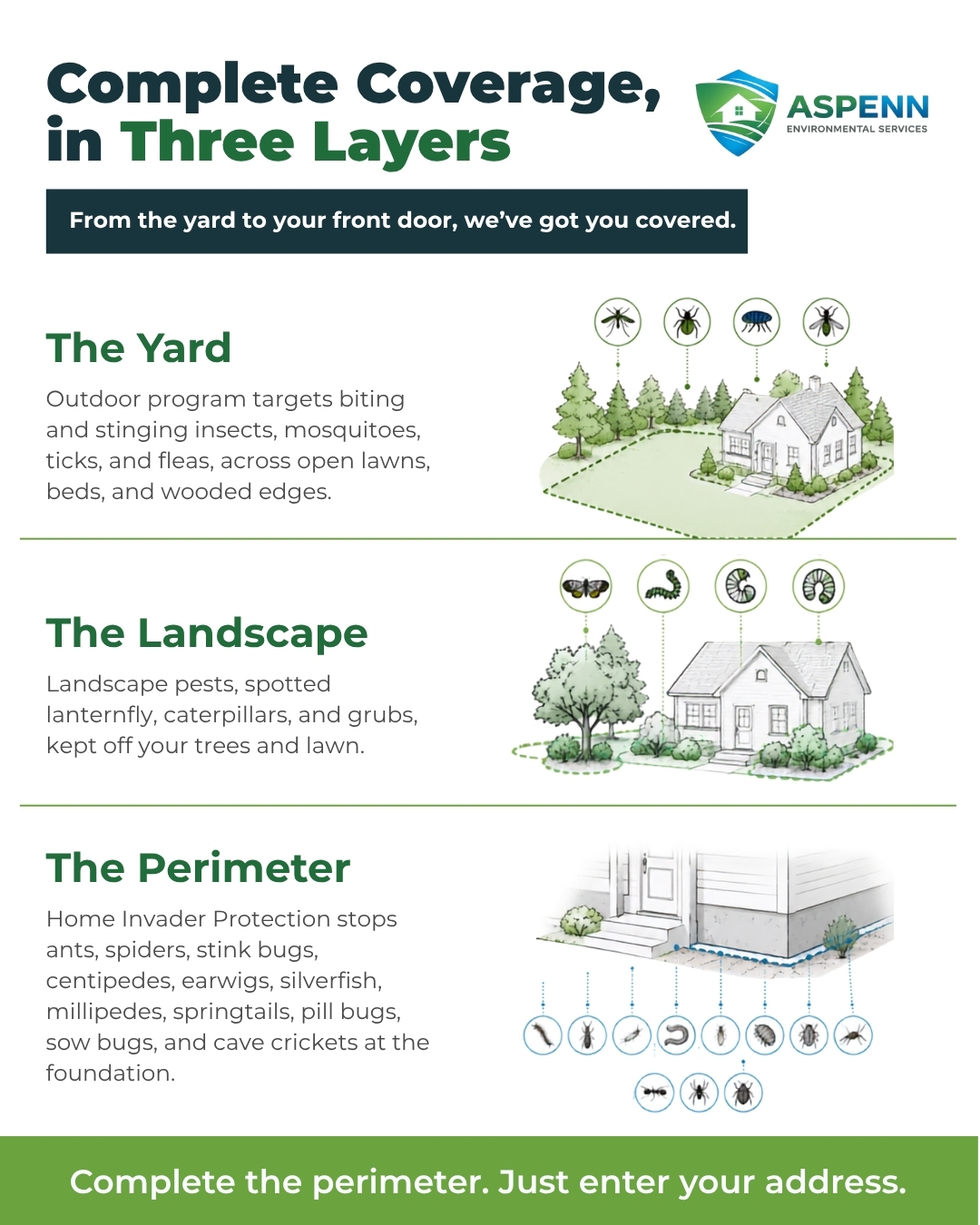
When people picture pest control, they think of ticks and mosquitoes. Those matter, but they’re only one part of the picture. Aspenn’s program is built around the full range of pests a Northeast property actually faces, and we group them by the way they behave, in three categories.
Biting and stinging insects
Mosquitoes, ticks, fleas, and the other biting and stinging insects that make a yard hard to enjoy and can carry disease. This is the core of the outdoor program.
Landscape pests
The bugs that damage what you’ve planted and grown: spotted lanternfly, caterpillar control, gypsy moth, grubs, and more. They threaten trees, shrubs, and lawns rather than people, but they can do real harm to a property over a season.
Home-invading pests
The ones that head for the house itself: ants, spiders, stink bugs, centipedes, earwigs, silverfish, millipedes, springtails, pill bugs, sow bugs, and cave crickets. These are the pests Home Invader Protection is designed to stop at the perimeter, before they become an indoor problem.
Naming all of this matters because the same property can have activity in all three categories at once. Understanding which pests you’re dealing with is the first step to covering them completely.
Cover all three layers. Enter your address at aspenn.com and see your exact price in seconds.
What Attracts Ants, Spiders, and Home Invaders to Your House?
Understanding what draws pests in makes it a lot easier to keep them out. Home invaders are almost always after one of three things: moisture, food, and shelter. Ants follow scent trails to crumbs, sugary spills, and pet food, and they love the damp soil against a foundation. Spiders go wherever other insects gather, so a home with a lot of bug activity outside tends to have more spiders looking to move in. Silverfish and springtails seek humidity, which is why bathrooms, basements, and crawl spaces attract them. Centipedes, millipedes, sow bugs, and pill bugs cluster in cool, moist spots like mulch beds pressed against the siding.
Your home also offers easy access. Gaps around windows and doors, cracks in the foundation, openings where utility lines enter, and shrubs touching the walls all give pests a bridge inside. Exterior lighting can draw insects at night, which in turn draws the spiders that feed on them. None of this means your house is dirty. It means it’s a comfortable, sheltered target, which is exactly why meeting these pests at the perimeter, before they find the entry point, works so well. And that’s exactly what Home Invader Protection is built to do. Add it to your coverage in about 30 seconds at aspenn.com.
How Do You Know If You Have a Home Invader Problem?
You usually see the signs before you see a swarm. The most common tip-offs are small and easy to shrug off until they add up: a line of ants tracking across the kitchen counter or along a baseboard, spiders setting up in basement corners, garages, and window frames, silverfish in bathrooms and around sinks, and earwigs, centipedes, or millipedes turning up in damp spots like the basement or the base of a wall.
Springtails, pill bugs, sow bugs, and cave crickets tend to cluster where it’s cool and moist, near foundations, in crawl spaces, and under mulch pressed against the house. If you’re noticing more activity along the edges where the floor meets the wall, near doors and windows, or anywhere close to the foundation, that’s the perimeter talking. It’s the signal that bugs are crossing the line from outside to in, and it’s exactly what a perimeter treatment is built to stop.
Are These Home Invaders Actually Dangerous?
For the most part, the common home invaders around a Northeast home are more nuisance than hazard, but a few are worth understanding. Most ants are a contamination and annoyance problem rather than a health threat, though they can get into food fast. Most house spiders are harmless and even helpful outdoors, but nobody wants them inside. Stink bugs don’t bite or sting, yet they cluster in large numbers and release an odor when disturbed. Silverfish can damage paper, books, and fabric over time. Centipedes can deliver a mild bite if handled but rarely bother people, and springtails, pill bugs, and sow bugs are harmless nuisances that usually signal too much moisture nearby.
The bigger health concerns sit in the biting-and-stinging category: ticks and mosquitoes, which can carry disease. That’s why the outdoor program treats them as a priority. The takeaway is simple: most home invaders won’t hurt you, but living with them is unpleasant, and a few can do quiet damage. Keeping all of them outside where they belong is the goal, and with the right coverage it’s a realistic one. Enter your address at aspenn.com for your exact price in seconds.
How Do I Get Rid of Ants and Spiders Getting Into My House?
It’s one of the most-searched pest questions there is, and the honest answer surprises people: the best way to stop ants and spiders inside is to treat outside. Nearly every ant trail on your counter and every spider in your basement started outdoors and found a way in. Chasing them indoors with sprays and traps treats the symptom. Treating the exterior perimeter treats the source.
That’s exactly what our Home Invader Protection does. A perimeter barrier, applied around the foundation and entry points with a backpack sprayer, intercepts ants, spiders, stink bugs, silverfish, centipedes, and the rest before they cross inside. Paired with the outdoor program, it’s the most reliable way to keep home invaders out without constant indoor spraying. If you’re tired of squishing bugs one at a time, this is the fix, and you can price it in seconds with just your address at aspenn.com.
Where Home Invaders Show Up Indoors, Room by Room
If you want to know what you’re dealing with, the room usually tells the story. In the kitchen, it’s typically ants, drawn to food and moisture around sinks and counters. In bathrooms, silverfish and the occasional centipede turn up around drains and damp corners. Basements and crawl spaces are prime territory for spiders, centipedes, millipedes, sow bugs, and springtails, since they’re cool, dark, and humid. Garages and entryways collect spiders and stink bugs, which slip in through gaps around doors.
Windowsills and the edges where the floor meets the wall are common sightings for almost everything, because those are the crossing points from outside to in. If you’re noticing activity in these spots, it’s a strong sign the pressure is coming from the perimeter. That’s useful to know, because it means the fix isn’t a can of spray under the sink. It’s stopping the flow at the foundation, which is exactly what Home Invader Protection is designed to do. Ready to seal it up? See your price and add coverage at aspenn.com.
What Can You Do Yourself, and Where Does a Pro Come In?
There are real steps you can take to make your home less inviting to pests, and they’re worth doing. Seal cracks and gaps around windows, doors, and where utility lines enter the house. Trim shrubs, tree limbs, and mulch back so they don’t touch the siding, since those are bridges pests use to reach the structure. Keep the lawn mowed, and reduce standing water and damp spots near the foundation, which draw ants, springtails, and centipedes.
Those habits help, but they have limits. Cracks reopen, landscaping grows back, and a bead of caulk won’t stop a determined ant colony or a summer surge of spiders. The step that actually holds the line is a professionally applied perimeter treatment, timed and reapplied across the season so the barrier stays strong when pest pressure peaks. Think of your own efforts as the first layer and our treatment as the one that makes it stick. Most homeowners find it’s far easier, and a lot more effective, to let us handle the perimeter than to fight it bug by bug.
Does Perimeter Pest Control Really Work?
Yes, when it’s done right. A perimeter treatment works by creating a treated band, sometimes called a bug band, around the exterior of your home that stops insects before they get inside. The keys are professional application and the right timing. A one-time DIY spray fades fast, which is why the perimeter needs to be treated on a schedule, generally a few times across the warm season, to stay effective as weather and pest activity change.
That’s how our program is built. The outdoor applications lower pest pressure across the whole yard, and the Home Invader Protection perimeter band, reapplied through the season, keeps the barrier strong right at the foundation. It’s the difference between a spray that works for a week and coverage that holds all season, and it’s backed by the Aspenn Protection Assurance if anything slips through between visits.
Professional Perimeter Treatment vs. DIY Sprays: What’s the Difference?
It’s fair to ask why you’d hire a company when the hardware store sells bug spray. The honest answer is that store-bought products can help in a pinch, but they rarely solve the problem, and here’s why. Consumer sprays tend to break down quickly, especially in sun and rain, so a weekend application often fades within days. Coverage is inconsistent when you’re guessing at the right spots, and the products available to homeowners are usually less durable than professional options applied correctly.
A professional perimeter treatment is different in three ways. It’s applied precisely with a backpack sprayer to the zones that actually matter: the foundation line, entry points, and the band where ground meets structure. It uses products chosen to leave a residue strong enough to keep working between visits. And it’s reapplied on a schedule across the season, so the barrier stays intact when pest pressure peaks instead of fading after a week. Add the Aspenn Protection Assurance, and you’re not gambling on a can and a dry afternoon. You’re getting coverage built to hold.
Common Myths About Perimeter Pest Control
A few myths keep homeowners from getting coverage they’d benefit from, so let’s clear them up. The first is that you have to spray inside to fix an indoor bug problem. In reality, treating the exterior perimeter stops most invaders before they get in, which is why an exterior-first approach usually means fewer indoor applications, not more. The second is that one treatment lasts all year. Pests run on a seasonal cycle, so a single spray can’t outlast months of pressure, which is why coverage is applied several times across the season.
A third myth is that professional treatment isn’t safe around kids and pets. Our applications are designed to be safe when applied properly; we leave patios and play areas untreated, and we recommend a short drying window of about 30 minutes. And the last one: that it’s a hassle to set up. With address-based instant pricing and automatic scheduling, getting started is genuinely faster than a trip to the store. Most of these myths are leftovers from old-school pest control. Modern, exterior-first, technology-driven service works differently, and you can see how easy it is right now: get your exact price in seconds at aspenn.com.
Why Do the Same Pests Come Back Every Summer?
It’s a fair question, and the answer is simple: pests run on a seasonal cycle, and a single treatment can’t outlast a whole season of pressure. As one generation is knocked down, weather, humidity, and breeding conditions bring the next wave, and peak summer heat only accelerates the push toward your home. A one-time spray in June does little for the surge in August.
That’s why our program is built as six applications across a 12-month cycle rather than a single visit, with the Home Invader Protection perimeter treatment layered in at the times invaders push hardest. Each application is timed to real pest activity and weather, so coverage stays consistent as conditions change. It’s the difference between reacting to bugs after you see them and staying ahead of them all season.
Why the Northeast Gets Hit by Pests Every Summer
There’s a reason pest pressure feels relentless here, and it’s not your imagination. The Northeast combines everything pests love: hot, humid summers that speed up breeding, plenty of rainfall and moisture, mature landscaping and tree cover, and a mix of older and newer homes with the kinds of gaps and foundations that invaders exploit. Properties that back onto woods, marshland, or open space sit right at the edge where ticks, mosquitoes, and other pests concentrate.
That regional pressure is exactly why a program designed for somewhere else doesn’t cut it here. Our applications are timed to Northeast conditions and the specific pests that thrive in them, from the biting insects in the yard to the home invaders pushing toward the foundation in peak heat. Living in the Northeast means planning for pests as a season, not a one-time event, and complete coverage is how you stay ahead of it year after year. Get ahead of it now, enter your address at aspenn.com for instant pricing.
What About Landscape Pests Like Spotted Lanternfly and Caterpillars?
Not every pest bites you, but some go after everything you’ve planted. Landscape pests are the second category in our program, and they can do real damage to a property over a season. Spotted lanternfly has become a serious problem across the region, swarming trees and stressing plants. Caterpillars, including gypsy moths, can strip foliage when populations spike. Grubs work below the surface, chewing roots and leaving brown patches in the lawn.
Our program keeps these landscape threats in view alongside the biting insects and home invaders, and for trees specifically we also offer targeted options like ArborSystems tree injection and deep-root landscape fertilizing. One of our longtime customers put it well in a review: they were one of the few properties with no gypsy moth issues during a bad year, a nice bonus on top of the tick and mosquito control. Protecting your landscape is part of protecting your whole property.
What’s the Difference Between Outdoor Pest Control and Home Invader Protection?
Think of them as two layers of the same shield. The outdoor program targets pest activity out in the yard, the open lawn areas, landscape beds, and wooded edges where mosquitoes and ticks live and breed. It’s what makes the yard usable again through the season.
Home Invader Protection is a perimeter add-on. Instead of the open yard, it focuses on the structural perimeter of your home, the foundation line, entry points, and the band where the ground meets the walls, to intercept ants, spiders, and other invaders right where they try to cross inside. One layer protects the space you live in outdoors. The other protects the line between outside and in. You get the most complete result when both are working at the same time.
How Does the Perimeter Treatment Work Alongside the Outdoor Program?
The two treatments are designed to complement each other, not overlap. Your outdoor applications are timed across the season to match pest activity in the yard. The Home Invader Protection perimeter treatment is applied to the exterior foundation and entry zones, recommended twice a year, positioned to catch invaders during the stretches when they push hardest toward the house, including peak summer heat.
Because both are exterior treatments applied with backpack sprayers, targeted and precise, they layer cleanly. The outdoor program lowers pest pressure across the property, and the perimeter band adds a focused line of defense right at the structure. The result is fewer bugs in the yard and far fewer making it to your door.
Why Does Exterior-First Coverage Mean Fewer Sprays Inside Your Home?
Here’s the part homeowners appreciate most: treating the outside well reduces the need to treat the inside at all. Most home-invading pests originate outdoors and work their way in. If you meet them at the perimeter, far fewer ever reach your living space, which means fewer reasons to spray indoors around your family, pets, and food.
That’s the whole philosophy behind our exterior-first approach. By concentrating treatment on lawns, landscape features, and the structural perimeter, we support strong, consistent control while keeping unnecessary interior applications to a minimum. It’s better for your home and better for the people and pets in it.
Where Exactly Does Aspenn Treat, and Where Doesn’t It?
This is worth being clear about, because it’s one of the things our customers value. We treat the open lawn areas, landscape beds, wooded edges, and the structural perimeter of the home- the places where pests actually live, breed, and cross inside.
We deliberately do not blanket the spaces where you relax and your kids play. Patios and play areas are left untreated by design, and every application is delivered with a backpack sprayer for precision, never a hose dragged off a truck or an old-fashioned pump sprayer. That targeted, modern approach is how we protect the property while keeping treatment off the surfaces where your family spends its time.
To be concrete about it: the open lawn where the kids run, the mulch beds along the house, the shaded edge where your yard meets the trees, and the foundation band around the structure are the zones that get treated. The deck where you eat dinner, the swing set, and the patio are not. That distinction is deliberate, and it’s a big reason our exterior-first approach works so well for families. You get strong control where pests actually live, and clean, untreated space where your family spends its time.
How Easy Is It to Add Home Invader Protection to My Plan?
If you’re already an Aspenn customer, adding perimeter coverage is about as easy as it gets. There’s no second quote process, no new property visit, and no starting over. We already have your address and your property measurements on file, so completing your coverage is a quick conversation or a click, and it’s added to your existing program.
If you’re new to Aspenn, it’s just as simple. You enter your address once, our system measures your property and prices everything instantly, and you can choose the outdoor program with Home Invader Protection included from the start. Either way, the hard part, figuring out your property, is already handled before anyone comes out.
Is It Worth Adding Perimeter Protection If You Already Have the Outdoor Program?
If you’re already seeing ants, spiders, or other invaders near the house despite a great-looking yard, the answer is almost certainly yes. The outdoor program and the perimeter treatment solve two different problems, and the perimeter band is what actually addresses the bugs headed for your door. Without it, there’s a gap right where it matters most, at the foundation.
Because there’s no second quote, no new property visit, and no starting over, completing your coverage is one of the easiest upgrades you can make. Most homeowners who add perimeter protection do it for the same reason: they’d rather stop the invaders at the wall than deal with them on the counter. It’s a small step that closes the loop on your protection, and it’s added right to the program you already have.
How Aspenn’s Technology Makes Getting Protected Effortless
This is where technology makes your life easier. Everything starts and finishes with your address, so you can get an exact price and get on the schedule from your couch in about a minute. Here’s how the convenience actually works.
Just the address
You enter your address online, and that’s the only thing we need to begin. Our system uses satellite measurement technology to calculate your property size, lawn area, and treatment zones automatically.
Instant, exact pricing
Because the property is measured from the address, you see your exact monthly or prepaid price in seconds, with no phone call required and no in-person visit.
Automatic, weather-smart scheduling
Once you’re set up, our system assigns your service dates automatically based on weather conditions, pest activity, and route efficiency, so your property is treated at the right time. Most first services happen within five to seven days.
Everything planned before arrival
By the time a technician pulls up, the plan, the timing, the pricing, and the treatment zones are already set. You don’t need to be home, and you’ll be notified before arrival and again when the service is complete. It’s precision-based, technology-driven pest control that respects your time.
What Makes Aspenn Different From Traditional Pest Control?
If your picture of pest control is a truck pulling up, a hose getting dragged across the yard, and someone walking the property with a clipboard, that’s the old way, and it’s exactly what we’ve moved past. A few things set Aspenn apart.
First, the technology. Your property is measured from your address using satellite technology, and AI, real-time environmental data, and predictive modeling help determine the right treatment at the right time. You get an exact price online in seconds, and everything is planned and priced before a technician arrives, which makes the whole experience fast and convenient. Second, the equipment. Every application is delivered with a backpack sprayer for precision and control, never a hose off a truck or an old manual pump sprayer. Third, the approach. We’re exterior-first, treating lawns, beds, wooded edges, and the perimeter while leaving patios and play areas untreated, which keeps unnecessary spraying away from your family. It’s precision-based pest control, built for how people actually live today.
How to Choose a Pest Control Company (and What to Watch For)
If you’re comparing pest control options, a few things separate a company worth hiring from one to skip. Look for genuine experience and a track record, since established companies with years behind them and a large base of real reviews tend to deliver more consistent results. Look for an exterior-first approach, because treating the source outside is more effective and keeps unnecessary spraying away from your living space. Ask how they price and schedule, because transparent, upfront pricing beats a vague quote you have to chase, and automatic scheduling means you’re not left managing it yourself.
Watch for a few red flags too: high-pressure sales tactics, prices that only appear after a rep walks your property, treatments that lean heavily on indoor spraying, and no clear guarantee. A strong company stands behind its work. Aspenn checks those boxes, with over 30 years of experience, more than 2,400 five-star reviews, exterior-first treatment, instant address-based pricing with no phone call required, backpack applications that stay off your patios and play areas, and the Aspenn Protection Assurance behind every program. Knowing what to look for makes the choice a lot easier. Ready when you are: get your exact price in seconds at aspenn.com, or call (888) 881-2847.
How Easy Is It to Reach Us? Communication You Can Count On
Great pest control isn’t only about the treatment. It’s about never being left guessing, and that’s something our customers mention constantly. From the first quote to every application, communication is quick and easy. You’re notified before a technician arrives and again when the service is complete, so you always know what’s happening at your property, even when you’re not home.
Our office team is genuinely easy to reach and quick to respond, whether you want to adjust timing, ask a question, or schedule a spray for a specific weekend before a party. Review after review names the same thing: a team that calls before and after, responds fast, and works with your schedule. When you need us, we’re a quick call or message away at (888) 881-2847 or info@aspenn.com.
Here’s how one longtime customer put it: “Kathy in the office is great, very friendly, very timely with reminders, and helpful in scheduling appointments when I want them done.” A verified Google review.
Is It Safe for Kids and Pets?
Yes. Our treatments are designed to be safe when applied properly and are commonly used in residential settings across the Northeast. We simply recommend letting treated areas dry before re-entry, which usually takes about 30 minutes. Combined with our exterior-first approach and the fact that patios and play areas are left untreated, it’s a program built with families and pets in mind. Many of our longtime customers tell us that peace of mind- safe for the kids, safe for the dog- is exactly why they’ve stayed with us for years.
Our reviews are full of pet owners who chose us specifically for that reason, people who tell us they haven’t found a single tick on their dogs, and families who feel good letting the kids back on the lawn once it’s dry. Safe application, exterior-first coverage, and untreated patios and play areas all work toward the same goal: real, effective pest control that fits a home with kids and pets in it.
A verified review sums it up: “Pet-friendly and pet-safe. Not one tick was found on my dogs. These guys are professional and courteous.” That’s the standard we hold every visit to.
How Much Does Pest Control Cost, and How Fast Can I Get Protected?
Cost is usually the next question, and we’ve made it refreshingly transparent. Outdoor plans typically range from $79 to $99 per month depending on your property size, with monthly or prepaid seasonal options, and Home Invader Protection is a straightforward add-on. But you don’t have to guess from a range, because you can see the exact price for your specific property in seconds.
Here’s how fast it goes. You enter your address, our system measures your property and calculates your price instantly, you choose your plan, and scheduling is automatic. Most first pest control services happen within five to seven days, with no phone call required and no need to be home. If you’ve been putting off protection because you dreaded the quote process, that process no longer exists. Getting protected is now the easy part. Enter your address at aspenn.com and see your price right now.
When Is the Right Time to Complete Your Coverage?
The honest answer is that the best time to complete your coverage is before you need it, and in the Northeast, that means now. Peak summer heat is precisely when home invaders push hardest toward the foundation, so waiting until you’re already seeing ants on the counter means playing catch-up. Getting the perimeter in place ahead of that surge helps keep the problem from starting in the first place.
There’s also a practical reason not to wait: the season keeps moving. Late summer rolls into fall, when ticks become active again, spotted lanternfly peaks, and invaders start looking for a warm way indoors as temperatures drop. The coverage you add today keeps working through all of it. Because adding perimeter protection is quick and requires no new quote or visit, there’s very little reason to put it off, and a real benefit to getting ahead of the next wave.
What Does Complete Seasonal Coverage Look Like Across the Northeast?
A complete Aspenn program runs as six applications across a 12-month cycle, timed to the Northeast’s specific pest pressure, with the Home Invader Protection perimeter treatment layered in. Over the season, that coverage spans all three categories: the biting and stinging insects in the yard, the landscape pests threatening your trees and lawn, and the home invaders pushing toward the structure.
And it’s all backed by the Aspenn Protection Assurance. If you notice unusual pest activity between scheduled treatments, we’ll return for a complimentary evaluation and, if needed, a targeted re-treatment. Complete coverage isn’t a single spray. It’s a coordinated, season-long plan designed to keep pressure down from spring through the following year.
Picture it across a year. Spring and early summer bring the first mosquito and tick pressure, and your applications are timed to meet it. Peak summer is when home invaders press toward the house, so the perimeter treatment does its heaviest work. Landscape pests like spotted lanternfly and caterpillars get attention as they emerge. And as fall arrives, ticks resurge, and invaders look for a way inside, right when the program is still protecting you. Complete coverage isn’t one moment. It’s the whole arc of the season, handled.
A Simple Seasonal Pest Calendar for Northeast Homes
Pests follow the calendar, and knowing the rhythm helps you stay ahead. In early spring, overwintering pests wake up, ants get active, and the first ticks appear as temperatures climb. Late spring into early summer brings peak mosquito breeding and heavy tick activity in shaded, humid areas- the time to make sure your outdoor coverage is in place. Peak summer heat is when home invaders push hardest toward the foundation looking for moisture and shelter, which is when perimeter protection earns its keep. Landscape pests like spotted lanternfly and caterpillars surge through the warm months.
As late summer turns to fall, ticks become active again, spotted lanternfly peaks, and invaders start seeking a warm way indoors as nights cool. Winter is quieter outdoors, though the groundwork for next season still matters. The point is that pest pressure isn’t a single moment. It’s a year-round cycle, which is exactly why our program runs as six timed applications across 12 months rather than a one-and-done spray. Coverage that follows the calendar keeps you protected through every phase of it. Lock in season-long protection today at aspenn.com, or call (888) 881-2847.
What Does the Aspenn Protection Assurance Guarantee?
Every Aspenn program is backed by the Aspenn Protection Assurance, and it’s simpler than most guarantees. If you experience unusual pest activity between your scheduled treatments, we’ll come back, perform a complimentary service evaluation, and, if it’s needed, a targeted re-treatment at no extra charge. You’re not left waiting until your next scheduled visit to get relief.
The reason we can stand behind that is the program itself. Six timed applications plus the perimeter add-on are designed to deliver consistent, season-long control when completed as scheduled, so the Assurance is a safety net rather than a crutch. It’s peace of mind on top of a plan that’s built to work, and it’s part of why so many customers stay with us year after year.
Looking for Pest Control Near You in New Jersey and the Northeast?
If you’ve been searching for pest control near me, mosquito control near me, or an exterminator in your town, you’re in the right place. Aspenn provides exterior pest control, mosquito and tick control, ant and spider control, and Home Invader Protection across New Jersey and the wider Northeast, with strong local coverage in Monmouth, Middlesex, Morris, Bergen, and Essex counties, and service extending into Connecticut, Delaware, Maryland, Massachusetts, New York, Pennsylvania, Rhode Island, Virginia, and Washington, D.C.
Because every property is priced instantly from its address, you can get your exact price and get on the schedule in seconds, right from your phone. You enter your address, see the exact price for your specific property, and you’re booked, all in about the time it took to read this. Local pest control has never been this convenient to start, and it begins at aspenn.com.
Where Do Ticks and Lyme Pressure Run Highest in New Jersey and Nearby Connecticut?
Tick and Lyme pressure is a real concern across the region, and it’s heaviest wherever homes meet natural habitat: wooded lots, properties backing to marshland or open space, and the shaded, humid edges where lawns give way to trees. Across New Jersey, that includes many neighborhoods in Monmouth, Middlesex, Morris, Bergen, and Essex counties, and the pattern holds just across the line in Connecticut and the wider tri-state, where similar landscapes create similar risk.
If your property has a wooded edge, a marshy back line, or mature landscaping, those transition zones are exactly where ticks concentrate, and exactly where our outdoor program focuses. Pairing that with perimeter protection means you’re covered from the tree line to the front door, wherever in the Northeast you are.
It’s worth taking seriously. Lyme and other tick-borne illnesses are a genuine health concern across the region, and the risk is highest exactly where people spend summer evenings, in those shaded, humid edges of the yard. One longtime customer shared that in nearly ten years of service, after multiple earlier tick bites that had sent a family member to the hospital, there hasn’t been a single bite since. That’s the kind of outcome that focused, well-timed tick control on the right zones is designed to support, and it’s why so many families here won’t go a season without it.
How to Protect Your Family From Ticks This Summer
Yard treatment is one layer of tick protection, and a smart homeowner pairs it with a few simple habits. After spending time outdoors, even in your own backyard, do a full-body tick check on yourself, your kids, and your pets, and remember that young ticks can be as small as a poppy seed. Showering within a couple of hours of coming inside helps wash off unattached ticks and gives you a chance to check. Ticks can also hitch a ride indoors on clothing and gear, so give those a look too. If you find one attached, remove it promptly with fine-tipped tweezers, grasping as close to the skin as possible.
On the yard itself, the classic guidance holds up: keep the lawn mowed, clear leaf litter and tall grass, and keep a barrier of wood chips or gravel between the lawn and any wooded edge, since ticks concentrate right at that line. This is exactly where professional tick control does the heavy lifting. Treating the shaded, humid edges of your property reduces how many ticks are out there to begin with, so your own checks catch far less. Layered protection, treatment plus habits, is how families here get through tick season with real peace of mind. Start with professional tick control on the zones that matter; see your price in seconds at aspenn.com.
Keep Mosquitoes Down: Get Rid of Standing Water
Mosquitoes need standing water to breed, and it takes shockingly little. A single bottle cap of stagnant water can produce hundreds of larvae, which is why the most effective thing you can do between treatments is eliminate standing water around your home. Walk your property once a week and empty or refresh anything holding water: clogged gutters, birdbaths, flowerpot saucers, kiddie pools, tarps, buckets, and forgotten toys. It’s a five-minute habit that pays off all season.
It matters longer than you might think, too. Mosquitoes stay active until temperatures consistently drop below about 60 degrees, which in the Northeast can mean well into the fall, and they can carry illnesses like West Nile virus. So the yard doesn’t stop needing attention in late August. Between your weekly standing-water sweep and our timed outdoor applications on the areas where mosquitoes rest and breed, you get the yard back for the whole warm season, not only the peak of it. Ready to take it back? Get your exact price at aspenn.com.
Getting Ahead of Fall Invaders: Seal the Gaps Before Mid-September
Here’s a seasonal tip worth acting on now. As nights cool toward fall, a wave of pests- stink bugs, boxelder bugs, Asian lady beetles, and the home invaders we’ve been talking about- starts clustering on warm, sun-facing siding and looking for a way inside. The single most effective do-it-yourself step is to seal the gaps before mid-September: caulk around windows and doors, add or repair weatherstripping, screen vents, and close up the small openings where utility lines enter the house.
Sealing helps, but gaps are everywhere, and pests are persistent, which is why the exterior perimeter treatment is the layer that actually holds the line. Applied around the foundation and entry points, it intercepts fall invaders before they reach those gaps in the first place. Pairing a good sealing weekend with Home Invader Protection is the one-two punch that keeps stink bugs and their friends from turning into an indoor problem once the weather turns. If you only do one proactive thing before fall, make it this. Even better, let us handle the perimeter for you; add Home Invader Protection in seconds at aspenn.com.
Are Ticks and Mosquitoes Still a Risk in September and October?
Yes, and it catches a lot of people off guard. It’s a common myth that pest season ends with Labor Day. In reality, ticks become active again in fall and remain a Lyme risk along wooded edges, and mosquitoes keep biting until the weather turns consistently cold. Meanwhile, home invaders are actively seeking a warm way indoors as the nights cool. Late summer into fall is arguably the worst time to let your protection lapse.
That’s the whole logic behind season-long coverage. Because our program runs as timed applications across a full 12-month cycle rather than a summer-only spray, you stay protected right through the stretch when a lot of homeowners have mentally checked out of pest season, which is exactly when ticks resurge and invaders head for the door. Staying covered through fall is one of the highest-value decisions you can make, and it’s already built into the plan. Don’t let your coverage lapse right when it matters most; see your price at aspenn.com.
A Homeowner’s Late-Summer Yard Checklist
If you want a simple, do-it-this-weekend list to keep pest pressure down between treatments, here it is:
- Empty or refresh anything holding standing water, including gutters, birdbaths, saucers, buckets, and toys, once a week.
- Mow the lawn and clear leaf litter and tall grass, especially along the edges.
- Keep a barrier of wood chips or gravel between the lawn and any wooded area.
- Trim shrubs, branches, and mulch back so they don’t touch the siding.
- Do a full-body tick check on people and pets after time outdoors.
- Seal cracks and gaps around windows, doors, and utility lines before mid-September.
Do those, and you’ve made your property a lot less inviting to pests. Pair them with professional coverage, the outdoor program for the yard and Home Invader Protection for the perimeter, and you’ve got the whole property handled. See your exact price in seconds at aspenn.com.
Complete Your Coverage in About 30 Seconds
Complete the perimeter. Just enter your address.
Here’s the whole reason this is easy: getting protected is genuinely fast and convenient. You enter your address, see your exact price for the outdoor program plus Home Invader Protection, and you’re on the schedule, with most first services within five to seven days. The bugs headed for your door aren’t waiting. You don’t have to either.
See your price and add coverage now: aspenn.com. Enter your address and your exact price appears in seconds, no phone call and no property visit required.
Already a customer: adding perimeter protection is quick and easy, no second quote. Call (888) 881-2847 or reach us at info@aspenn.com, and we’ll add it to your program.
Prefer to talk first: call (888) 881-2847. The team is glad to help.
Aspenn Environmental Services | 1430 Jersey Ave, Ste 1, North Brunswick, NJ 08902 | (888) 881-2847 | aspenn.com | 30+ years and 279+ 5-star reviews across the Northeast.