
What This Guide Covers
- Why is pest pressure at its highest point of the year right now
- What changes as summer moves toward fall, and why it matters
- How ticks, mosquitoes, spotted lanternfly, and home invaders behave through the season
- Whether a summer-only treatment holds up, and where it falls short
- What the 12-month program covers, backed by the Aspenn Protection Assurance
- Where pest pressure runs highest across New Jersey and the Mid-Atlantic
- How to get protected in seconds, just your address, no phone call
It is peak season for pests across the Northeast. Mosquitoes and ticks are active in every yard, and in the summer heat, ants, spiders, and other home invaders are already pushing toward the foundation in search of moisture and shelter. This is the highest-pressure stretch of the year, and it is exactly when protection matters most. For homeowners in New Jersey, New York, Pennsylvania, and the wider Northeast, the practical question is simple: with the bugs this active, who handles it, and how easily?
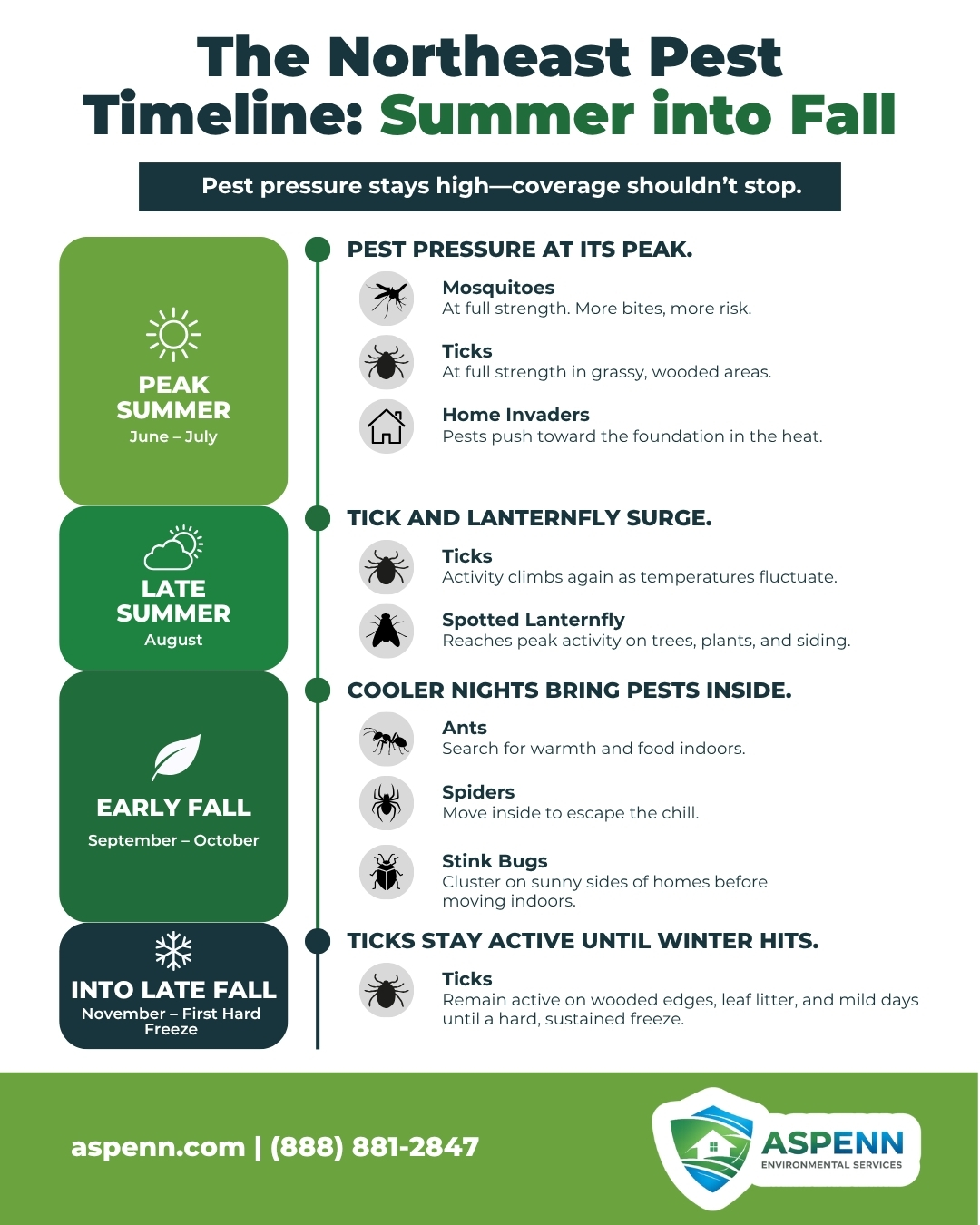
The season also does not stop here. As summer moves toward fall, tick activity climbs again along wooded edges, spotted lanternfly reaches its peak on trees and landscapes, and invaders press harder toward the warmth of your home. Coverage you lock in now protects your property through all of it. With Aspenn, that coverage starts and ends with your address: no property walk, no phone call. You enter your address, see your exact price in seconds, and our team handles the treatment on an automatic schedule, backed by the Aspenn Protection Assurance. Read straight through for the full picture, or jump to the section you need.
Why Is Pest Pressure at Its Peak Right Now?
Summer is the height of pest activity in the Northeast, and it is not close. Warm temperatures speed up breeding, humidity and rainfall keep the ground and landscaping favorable, and long days give mosquitoes and ticks more time to feed. Mosquitoes are breeding in any standing water they can find, ticks are questing along every shaded, humid edge where the lawn meets taller growth, and the biting and stinging insects that make a yard hard to enjoy are at full strength.
At the same time, the summer heat drives a second group toward your house. Ants, spiders, and other home invaders hunt for the moisture and cool shelter your foundation provides, which is why activity picks up along baseboards, windowsills, and garage doors during the hottest stretches. Two things are happening at once: the yard is under pressure, and the structure is, too. Meeting both outdoors at the same time is what keeps the season manageable.
What Changes as Summer Moves Toward Fall?
The season does not wind down as summer ends. It shifts. Adult ticks become active again and keep spreading Lyme along wooded edges on any day above freezing, which extends tick pressure well past summer. Spotted lanternfly reaches its loud, obvious peak, clustering on trees and siding across New Jersey and the Mid-Atlantic and laying the egg masses that seed next year. And as nights cool, home invaders push harder toward the warmth of the house, looking for a way inside before the first cold snap.
The takeaway is that the calendar keeps moving, and so do the pests. Coverage that follows the season, rather than a single summer treatment, is what carries protection from the peak of summer through the fall surge without a gap. That continuity is built into the way our program runs.
Do Ticks Slow Down When Summer Ends?
This is one of the most-searched pest questions, and the answer surprises people: ticks do not shut off with the summer. Adult black-legged ticks, the ones that carry Lyme disease, stay active any time the temperature climbs above freezing, which in the Northeast means plenty of days well into fall and even winter. They shelter in leaf litter and brush during a hard freeze, then come right back out on the next mild stretch. A single warm afternoon in November can put a tick on a dog after a walk along the tree line.
That is why a treatment that ends when summer does leaves a gap during weeks when ticks are still out and still carrying disease. Continuous, season-long coverage closes that gap, which is why tick control is a year-round decision in the Northeast, not a summer one. Our outdoor program treats the shaded, humid edges where ticks concentrate through the entire active season, so far fewer are ever out there to reach your family and your pets.
Why Do Mosquitoes Stay Active Past Summer?
Mosquitoes do not stop when the calendar turns. They stay active until temperatures hold consistently below about 60 degrees, which in the Northeast can mean well into the fall, and they can carry illnesses like West Nile virus during that stretch. Between treatments, the most effective step is eliminating standing water, since it takes a bottle cap of stagnant water to breed hundreds of larvae. Anything holding water- clogged gutters, birdbaths, flowerpot saucers, tarps, and buckets- is worth emptying once a week.
The rest is ours to handle. Our timed outdoor applications target the shaded, low-lying areas where mosquitoes rest and breed, so the yard stays usable through the whole warm season, not only its peak. One reviewer with marshland behind the yard described the difference plainly: the space was unusable because of mosquitoes until Aspenn started coming, and then they were gone.
Spotted Lanternfly Reaches Its Peak in Late Summer
If gray-and-red winged insects are swarming tree trunks, siding, and outdoor furniture, that is spotted lanternfly, and late summer is when it peaks. This invasive pest has spread aggressively across New Jersey, Pennsylvania, and the wider Mid-Atlantic, and the adults cluster in large numbers this time of year before laying the egg masses that start next season. Beyond the nuisance, lanternfly stresses trees by feeding on sap and leaves behind a sticky honeydew that grows a black sooty mold on whatever sits below.
This is the highest-value window to act, because treating the adults at peak reduces the eggs that seed next year. Aspenn’s Spotted Lanternfly Control Application targets them as part of the landscape-pest side of the program, with options like ArborSystems tree injection for the trees you most want to protect. You do not have to identify life stages or reach high branches yourself. The treatment handles it.
Why Do Home Invaders Push Toward the House?
Home invaders move toward the house for two reasons across the season. In the summer heat, ants, spiders, centipedes, and silverfish come looking for the moisture and cool shelter your foundation offers. Then as nights cool toward fall, stink bugs, boxelder bugs, and the same crew press in again, this time hunting for a warm place to overwinter. Either way, they slip through the smallest gaps around windows, doors, and utility lines, and once a few find the path, more follow it.
The reliable way to stop them is not a can of spray after you already see them inside. It is a treated exterior perimeter that meets these pests at the foundation before they cross the threshold. Aspenn’s Home Invaders Application puts a backpack-applied band exactly where they try to enter, so far fewer ever reach your living space, in the peak of summer and again as the season turns.
Can Someone Just Handle the Ticks for Me?
Yes, and that is the whole idea. Ticks carry Lyme disease and other illnesses, which gives them the highest health stakes of any pest on the property, and the last thing you want is a season spent doing tick checks and hoping for the best. You do not have to manage it yourself. Our outdoor program treats the shaded, humid edges of your yard where ticks wait, the border along the tree line, the leaf-littered corners, and the transition zones, so there are far fewer out there to reach your family and your pets.
That is the heavy lifting, and it is ours to do. One longtime customer summed up the result in a review: never a worry about ticks. Getting that peace of mind takes only your address, with an exact price in seconds, automatic scheduling timed to real tick activity, and a team that keeps you posted before and after every visit.
Not Sure What the Bug Is? You Don’t Have to Be.
Here is the most reassuring part of how Aspenn works: you do not have to identify the bug. You do not have to research the right product, figure out where it is getting in, or decide how often to treat. That is our job, and we have done it across the Northeast for more than 30 years.
Whether it is ants in the kitchen, spiders in the basement, or something you cannot name that simply does not belong in your house, the path to handled is the same. Enter your address at aspenn.com. Our system measures your property from satellite imagery and shows your exact price in seconds, with no phone call and no in-person quote. You pick your plan, we schedule automatically around the weather and your area’s pest activity, and you are notified before we arrive and when we are done. You do not even need to be home. The bug becomes our problem, not yours.
Are Home Invaders a Sign of a Dirty House?
Finding ants, spiders, or other invaders around the house does not mean your home is dirty. It means your home is warm, sheltered, and sitting in the middle of a Northeast summer, which is exactly what these pests are looking for. Even a spotless house offers the three things they want: moisture, shelter, and small gaps to slip through around windows, doors, and utility lines. Spiders follow the other insects, and the rest follow moisture and warmth.
So the goal is not to scrub harder. It is to make the outside of the home a place where these pests cannot get a foothold. That is what an exterior perimeter treatment does: it meets them at the foundation before they find the crack that lets them in. A little sealing helps, but gaps are everywhere, and pests are persistent. The reliable fix is a treated perimeter band, reapplied on the schedule that matches pest pressure, so the barrier stays strong when it counts.
Can Store-Bought Sprays Keep Up?
Consumer products can help in a pinch, but they rarely solve the problem. Store-bought sprays break down fast in sun and rain, so a weekend application often fades within days, right as the next wave of pressure arrives. Coverage is inconsistent when you are guessing at the right spots, and the products available to homeowners are less durable than professional options applied correctly. The result is constant reapplication and bugs that keep coming back one at a time.
A professional treatment is different in three ways. It is applied precisely with a backpack sprayer to the zones that matter: the wooded edges, the foundation line, and the entry points where pests cross. It uses products chosen to leave a residue strong enough to keep working between visits. And it is timed to real pest activity rather than a random Saturday, so the barrier holds when pressure peaks. Add the Aspenn Protection Assurance, and it is coverage built to last the season, applied by a team that has done it across the Northeast for more than 30 years.
Why Does Exterior-First Treatment Keep Sprays Out of Your Home?
Treating the outside well reduces the need to treat the inside at all. Nearly every home invader originates outdoors and works its way in. Meet them at the exterior perimeter, and far fewer ever reach your living space, which means fewer reasons to spray indoors around your family, your pets, and your food. Chasing bugs room by room with indoor sprays treats the symptom. Meeting them at the foundation treats the source.
That is the philosophy behind our exterior-first approach. We concentrate treatment on lawns, landscape beds, wooded edges, and the structural perimeter, and we deliberately leave patios and play areas untreated. Every application goes on with a backpack sprayer for precision, never a hose dragged off a truck. The perimeter band turns invaders back before they find the gap, so the inside of your home stays largely spray-free. It is the model Aspenn runs across ten Northeast states, all year.
Fleas Ride In on Pets
Fleas are easy to forget about until one hitchhikes a ride indoors on the dog and the whole family is dealing with them. They come from the same outdoor spaces where pets play: the lawn, the shady corners, and the edges of the yard. Warm weather keeps them active, and a comfortable home is exactly where they want to be.
Fleas are covered under our Tick & Flea Control, treated right alongside the ticks in the zones where both concentrate. So instead of bombing the house or bathing the dog on repeat, you let us lower the pressure at the source outdoors, where the fleas are actually coming from. As with everything else, starting takes only your address, with an exact price in seconds and automatic scheduling.
Why Stopping Coverage Now Is the Costly Move
It can be tempting to treat pest control as a short summer expense and let it lapse. The problem is timing. Pest pressure does not drop off when the season shifts; it changes shape. Ticks resurge, lanternfly peaks, and invaders press toward the house, so a gap now gives every one of them an opening right when pressure is high. One customer described taking a year off and being stunned by the difference: you do not know what you have until it is not there.
That is the logic behind season-long coverage. Because our program runs as six timed applications across a full 12-month cycle rather than a summer-only spray, you stay protected right through the stretch when ticks resurge and invaders head for the door, backed by the Aspenn Protection Assurance if anything shows up between visits. Locking coverage in now protects the progress the whole warm season has built.
What Does the 12-Month Program Cover?
A complete Aspenn program runs as six applications across a 12-month cycle, timed to real Northeast pest pressure rather than a fixed calendar. Over the season, coverage spans all three pest families: the biting and stinging insects in the yard, mosquitoes, ticks, and fleas; the landscape pests threatening trees and lawns, spotted lanternfly, caterpillars, and grubs; and the home invaders pushing toward the structure, ants, spiders, and the rest. Home Invader Protection layers a perimeter treatment in when invaders push hardest.
Because the applications are timed to weather and pest activity, coverage stays consistent as conditions change from peak summer into fall. It is the difference between reacting to bugs after you see them and staying ahead of them the whole way through, so the fall surge is handled before it arrives.
What Is the Aspenn Protection Assurance?
Every Aspenn program is backed by the Aspenn Protection Assurance, and it is simpler than most guarantees. If you notice unusual pest activity between scheduled treatments, we come back, perform a complimentary service evaluation, and, if it is needed, a targeted re-treatment at no extra charge. You are not left waiting until the next scheduled visit to get relief.
The program is what lets us stand behind it. Six timed applications plus the perimeter add-on are designed to deliver consistent, season-long control, so the Assurance is a safety net rather than a crutch. It is peace of mind on top of a plan built to work, and part of why Aspenn has earned more than 2,400 five-star reviews across the Northeast.
How Fast Can I Get Protected?
The old quote process barely exists anymore. You enter your address at aspenn.com, our system measures your property from satellite, and your exact monthly or prepaid price appears in seconds, with no phone call and no in-person visit. You choose your plan, scheduling is automatic based on weather and route, and most first services happen within five to seven days. You do not need to be home, and you are notified before the technician arrives and again when the service is complete.
If getting a quote has ever felt like a chore, that reason is gone. Getting protected is now the easy part, and routes across New Jersey and the Mid-Atlantic are filling as homeowners lock in coverage for the rest of the season.
Where Does Pest Pressure Run Highest in New Jersey and the Mid-Atlantic?
Pest pressure is heaviest wherever homes meet natural habitat. For ticks, that means wooded lots, properties backing to marshland or open space, and the shaded, humid edges where lawns give way to trees. Across New Jersey, that includes many neighborhoods in Monmouth, Middlesex, Morris, Bergen, and Essex counties, and the same pattern holds south into Pennsylvania, Delaware, Maryland, and the wider Mid-Atlantic, where similar landscapes create similar risk.
Spotted lanternfly follows a different map but an equally clear one, spreading hard across New Jersey and Pennsylvania and pushing through the Mid-Atlantic on tree-lined and landscaped properties. If your property has a wooded edge, mature trees, or a marshy back line, those are exactly the zones where pests concentrate, and exactly where our program focuses. Because every property is priced instantly from its address, you can get your exact price and get on the schedule in seconds, wherever in the Northeast you are.
What Makes Aspenn Different From Traditional Pest Control?
If your picture of pest control is a truck pulling up, a hose dragged across the yard, and someone walking the property with a clipboard, that is the old way, and it is exactly what we have moved past. First, the technology: your property is measured from your address using satellite technology, and AI, real-time environmental data, and predictive modeling help determine the right treatment at the right time. You get an exact price online in seconds, with everything planned before a technician arrives. Second, the equipment: every application is delivered with a backpack sprayer for precision, never a hose off a truck or an old manual pump sprayer.
Third, the approach. We are exterior-first, treating lawns, beds, wooded edges, and the perimeter while leaving patios and play areas untreated, which keeps unnecessary spraying away from your family. It is precision-based pest control built for how people actually live, delivered across ten Northeast states.
Is the Treatment Safe for Kids and Pets?
Yes. Our treatments are designed to be safe when applied properly and are commonly used in residential settings across the Northeast. We recommend letting treated areas dry before re-entry, which usually takes about 30 minutes. Combined with our exterior-first approach and the fact that patios and play areas are left untreated, it is a program built with families and pets in mind.
A verified review sums it up: “Pet-friendly and pet safe. Not one tick found on my dogs. These guys are professional and courteous.” That’s the standard we hold every visit to.
How Does Aspenn’s Address-Based Technology Work?
Everything starts and finishes with your address, so you can get an exact price and get on the schedule from your couch in about a minute. You enter your address online, and our system uses satellite measurement technology to calculate your property size, lawn area, and treatment zones automatically. There is no property walk and no waiting on a rep to call you back.
Because the property is measured from the address, you see your exact price in seconds, and then scheduling is automatic. Our system assigns service dates around weather conditions, pest activity, and route efficiency, so your property is treated at the right time rather than a random one. By the time anyone pulls up, the plan, the timing, and the treatment zones are already set. It is precision-based, technology-driven pest control that respects your time, delivered across ten Northeast states.
Why Late Summer Is the Highest-Value Time to Lock In Coverage
Late summer is the highest-value moment to lock in coverage, because the pressure is high now and it is about to change shape rather than fade. Ticks are active and will resurge again. Spotted lanternfly is at peak and laying next year’s eggs. Home invaders are pressing toward the house in the heat and will press again as it cools. Mosquitoes will keep biting until a sustained cold finally sets in. Every one of those pressures is climbing at once.
Coverage you put in place now protects the whole run, from the peak of summer through the fall surge, with nothing for you to track. Because our program already runs as timed applications across a full 12-month cycle, staying covered is not a separate decision. Starting is just as easy: your address, an exact price in seconds, and automatic scheduling.
Why Does the Northeast Get Such Heavy Pest Pressure?
Pest pressure feels relentless here for a reason. The Northeast combines everything pests thrive on: hot, humid summers that speed up breeding, steady rainfall and moisture, mature landscaping and tree cover, and a mix of older and newer homes with the gaps and foundations that invaders exploit. Properties that back onto woods, marshland, or open space sit right at the edge where ticks, mosquitoes, and other pests concentrate, which puts more pressure on the yard and the structure at once.
That regional reality is why a program designed for somewhere else does not hold up here. Our applications are timed to Northeast conditions and the specific pests that thrive in them, from the biting insects in the yard to the invaders pushing toward the foundation in peak heat. Living in the Northeast means planning for pests as a season, not a single event, and continuous coverage is how a property stays ahead of it.
How Do You Choose a Pest Control Company?
If you are comparing options, a few things separate a company worth hiring from one to skip. Look for genuine experience and a real track record, since an established company with years of work and a large base of real reviews tends to deliver more consistent results. Look for an exterior-first approach, because treating the source outside is more effective and keeps unnecessary spraying away from your living space. And ask how a company prices and schedules, because transparent, upfront pricing beats a vague quote you have to chase, and automatic scheduling means you are not left managing it yourself.
A few red flags are worth avoiding: high-pressure sales tactics, prices that only appear after a rep walks your property, treatments that lean heavily on indoor spraying, and no clear guarantee. Aspenn was built to be the opposite, with over 30 years of experience, more than 2,400 five-star reviews, exterior-first treatment, instant address-based pricing with no phone call, backpack applications that stay off patios and play areas, and the Aspenn Protection Assurance behind every program.
What Does Complete Seasonal Coverage Include?
A complete program is not a single spray; it is a coordinated plan across the year. Six applications are timed to real pest activity and weather, and over the season they span all three pest families: the biting and stinging insects in the yard, the landscape pests that threaten trees and lawns, and the home invaders that push toward the structure. The Home Invader Protection perimeter treatment layers in when invaders press hardest, in the peak of summer heat and again as the season cools.
Picture it across the warm season. Summer brings peak mosquito and tick pressure, and the applications are timed to meet it. Landscape pests like spotted lanternfly and caterpillars get attention as they emerge and peak. And as the season turns, ticks resurge, and invaders look for a way inside, right when the program is still protecting the property. Complete coverage is the whole arc of the season, handled, and every bit of it is backed by the Aspenn Protection Assurance.
Do I Need Perimeter Protection If I Already Have the Outdoor Program?
If you already have outdoor coverage but still see ants or spiders near the house, the answer is almost certainly yes. The outdoor program and the perimeter treatment solve two different problems. The outdoor applications lower pest pressure across the yard, while Home Invader Protection puts a treated band right at the foundation and entry points to intercept the invaders headed for your door. Without it, there is a gap exactly where it matters most, at the structure.
Adding it is one of the easiest upgrades there is. For an existing customer, there is no second quote and no new property visit, because we already have the address and property measurements on file. For a new customer, the outdoor program and perimeter coverage can be priced together from the start. Either way, the hard part, figuring out your property, is already handled before anyone comes out.
How Does Aspenn Schedule and Keep You Informed?
Great pest control is more than the treatment. It is never about being left guessing. Once you are set up, our system assigns your service dates automatically based on weather, pest activity, and the most efficient route to your street, so the property is treated at the right time. You are notified before a technician arrives and again when the service is complete, so you always know what is happening at your property, even when you are not home.
Our office team is quick to reach and quick to respond, whether you want to adjust timing or ask a question. One customer summed it up in a review: the scheduling is very flexible. Notice before and after every visit, fast responses, and working around your schedule are the standard. When you need us, we are a quick message or call away at (888) 881-2847 or info@aspenn.com.
Does Perimeter Pest Control Really Work?
Yes, when it is done right. A perimeter treatment works by creating a treated band around the exterior of your home that stops insects before they get inside. The keys are professional application and the right timing. A one-time consumer spray fades fast, which is why the perimeter needs to be treated on a schedule across the active season to stay effective as weather and pest activity change.
That is how our program is built. The outdoor applications lower pest pressure across the whole yard, and the Home Invader Protection perimeter band, reapplied through the season, keeps the barrier strong right at the foundation. It is the difference between a spray that works for a week and coverage that holds, and it is backed by the Aspenn Protection Assurance if anything slips through between visits.
What Happens on Your First Aspenn Service?
Once you enter your address and choose your plan, the rest is handled for you. Our system already knows your property size and treatment zones from the satellite measurement, so nothing needs to be walked or measured in person. Scheduling is automatic, and most first services happen within five to seven days. You are notified before the technician arrives, so there are no surprises, and you do not need to be home for the treatment.
On the visit itself, the technician treats the zones that matter- the lawn, the landscape beds, the wooded edges, and the structural perimeter- with a backpack sprayer and leaves your patio and play areas untreated. You are notified again when the service is complete. From there, the program runs on its schedule, and the Aspenn Protection Assurance covers anything unusual between visits. There is nothing for you to track.
Your Trees and Lawn Are Part of the Program
Not every pest bites you, but some go after everything you have planted. Landscape pests are a core part of the program, and they can do real damage over a season. Spotted lanternfly stresses trees and leaves a sticky residue. Caterpillars can strip foliage when populations spike. Grubs work below the surface, chewing roots and leaving brown patches in the lawn. Left alone, these pests turn a healthy landscape into a season of repair.
Our program keeps these threats in view alongside the biting insects and home invaders, and for trees specifically, we offer targeted options like ArborSystems tree injection and deep-root landscape fertilizing to keep them strong. Protecting the trees and lawn is part of protecting the whole property, and it is handled on the same simple, address-based plan as everything else.
Reclaim the Yard You Actually Pay For
A backyard is one of the best parts of a home, and pests are the fastest way to lose it. Mosquitoes turn an evening on the patio into a retreat indoors. Ticks make parents think twice about letting kids and pets roam the grass. A yard you cannot comfortably use is square footage you are paying for and not enjoying. The point of a program is simple: fewer bugs and a yard you can use again.
When the biting insects are down across the lawn and the wooded edges, the yard becomes usable again, for dinners outside, for the kids, for the dog. That is the outcome customers describe most: not a technical result, but evenings they can spend outdoors without swatting or worrying. Protection that runs all season is what makes the yard dependable, weekend after weekend.
Why Timing Matters More Than the Number of Sprays
Pests run on a seasonal cycle, so a single treatment cannot hold a line for months. As one generation is knocked down, weather, humidity, and breeding conditions bring the next wave, and the summer heat only accelerates the push toward your home. A one-time treatment in June does little for the pressure in August, and nothing for the surge as the season turns.
That is why the program is built as six applications across a 12-month cycle rather than a single visit, each one timed to real pest activity and weather instead of a fixed date. Coverage stays consistent as conditions change, so the barrier is strongest exactly when pressure peaks. It is the difference between reacting to pests after you see them and staying ahead of them the whole way through, which is the entire point of a season-long plan.
Get Protected in Seconds
The pests are at full strength now, and the season only shifts from here. Enter your address at aspenn.com, see your exact price, and you are on the schedule- most first services within five to seven days, no phone call and no property visit required. Whatever is active in your yard, and whatever is coming next, it becomes our job, not yours.
See your price and get covered: aspenn.com. Or call (888) 881-2847 if you’d rather talk.