
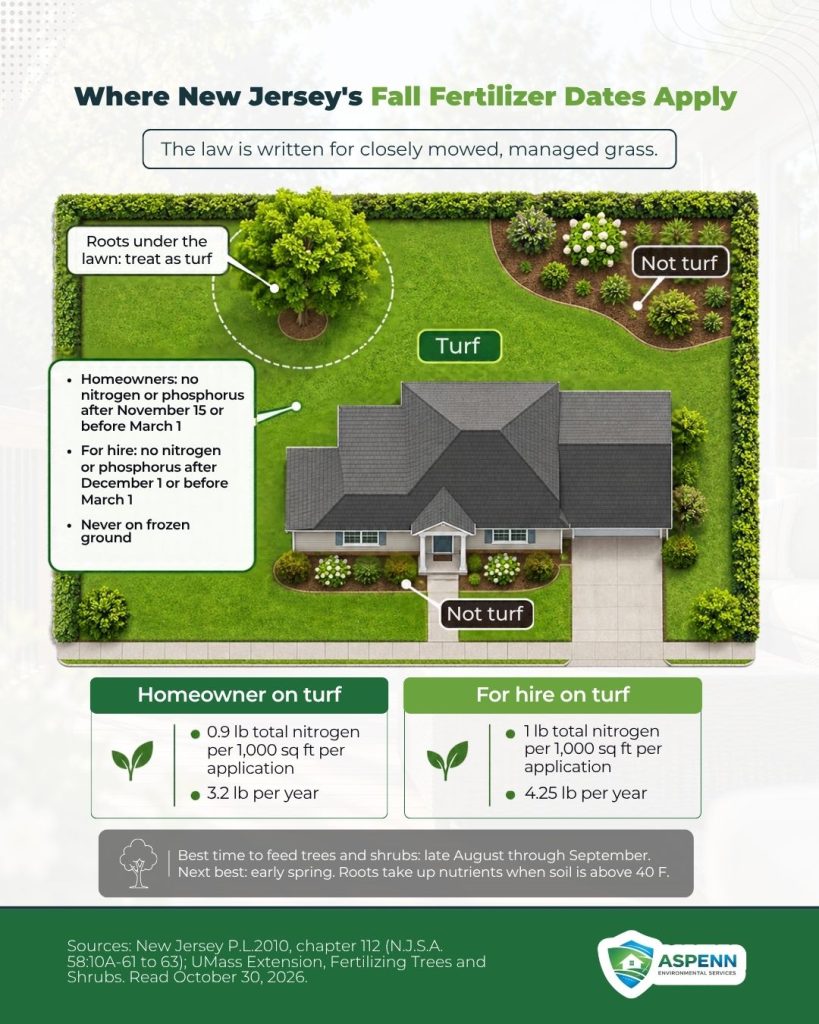
New Jersey’s fall fertilizer cutoff applies to turf, and the law defines turf as closely mowed, managed grass. A shrub bed, a mulched tree ring or a foundation planting is not turf, so the November 15 date for homeowners and the December 1 date for hired applicators do not reach them. What still limits a late feeding for a tree is biology: roots take up nutrients until the soil nears freezing, and the best window has already passed.
TL;DR
New Jersey’s fertilizer law, P.L.2010, chapter 112, bars homeowners from putting nitrogen or phosphorus on turf before March 1 or after November 15, and bars anyone fertilizing for hire after December 1, with frozen ground off limits at any date. Every one of those rules is written about “turf”, which the statute defines as land planted in closely mowed, managed grass. Trees and shrubs growing in beds or mulch sit outside that definition. For timing, UMass Extension puts the best window for feeding woody plants at late August through September, says root uptake stays strong until soil temperatures approach freezing, and names early spring as the next best time. So when to fertilize trees in NJ is a soil question in November, not a legal one, unless the roots you are feeding sit under the lawn. Phosphorus needs a soil test or one of the statute’s listed exceptions.
What Counts as Turf Under the New Jersey Fertilizer Law?
Turf, under New Jersey’s fertilizer law, means land “planted in closely mowed, managed grass”, including residential property and publicly owned land, with golf courses and commercial farms carved out. That definition sits in section 1 of P.L.2010, chapter 112, as printed by the New Jersey Legislature (https://pub.njleg.gov/Bills/2010/PL10/112_.PDF), and the date rules in section 2 all hang on it.
Read the definition slowly and the shape of the law changes. It does not ban fertilizer in late fall. It bans fertilizer on a particular kind of ground in late fall.
Here is how that sorts the parts of an ordinary yard:
| Part of the yard | Is it turf under the statute? | Do the fall dates apply? |
|---|---|---|
| Front and back lawn | Yes, closely mowed, managed grass | Yes |
| Mulched shrub border along the foundation | No | No |
| Bed of azaleas, hollies or arborvitae | No | No |
| Mulched ring around a specimen tree | No | No |
| A tree whose root zone runs under the lawn | The ground above those roots is turf | Treat it as turf (see below) |
| Meadow or unmowed grass | Not “closely mowed” | Not clearly covered |
The last two rows are where people get tripped up, and they get their own section further down.
The rest of the statute keeps returning to the same word. The heavy rain rule, the frozen ground rule, the nitrogen caps and the water buffer are each written about turf. Phosphorus is the one place the law speaks more broadly, which matters for tree feeding and is covered below.
The Dates, the Caps and Who They Bind
The law splits people into two groups. Anyone fertilizing their own lawn is one. The other is what the statute calls a “professional fertilizer applicator”, defined as anyone who applies fertilizer for hire, town employees included.
| Rule for turf | Homeowner | Applicator working for hire |
|---|---|---|
| No nitrogen or phosphorus before | March 1 | March 1 |
| No nitrogen or phosphorus after | November 15 | December 1 |
| Frozen ground | Never | Never |
| Total nitrogen per application | 0.9 lb per 1,000 sq ft | 1 lb per 1,000 sq ft |
| Water-soluble nitrogen per application | 0.7 lb per 1,000 sq ft | 0.7 lb per 1,000 sq ft |
| Total nitrogen per year | 3.2 lb per 1,000 sq ft | 4.25 lb per 1,000 sq ft |
| Certification to apply | Not required | Required, or training under a certified applicator |
A few more turf rules ride along. Nobody may fertilize turf when heavy rain is falling or forecast, or when the soil is saturated. Fertilizer that lands on a driveway, patio, or walk has to be swept or blown back. Turf within 25 feet of a lake, stream, or pond is off limits; cut to 10 feet with a drop spreader, a rotary spreader with a deflector, or a targeted liquid spray.
Penalties and who enforces them
For-hire applicators face a civil penalty of $500 for a first offense and up to $1,000 for each one after that, and a violation that continues counts each day again. The Department of Environmental Protection’s courtesy copy of the Water Pollution Control Act, updated through 2016, prints these penalty terms, dates and caps unchanged from the 2010 enactment. Homeowners face whatever penalty their own municipality sets by ordinance. Towns, counties, soil conservation districts and local health agencies can all enforce it.
Why Millburn and Montclair cannot move the dates
Section 7 preempts any municipal, county, or health agency ordinance about fertilizer on turf. So the November 15 and December 1 dates are the same in Millburn Township, Short Hills included, as they are in Montclair. The preemption clause is written about turf too, which leaves a town free to say something about beds and trees, so a glance at your own township code before a late bed feeding costs nothing.
That enactment was approved on January 5, 2011, and it has governed every fall in Short Hills, Millburn, and Montclair since.
When Should You Fertilize Trees in New Jersey?
The best time to fertilize established trees and shrubs is late August through September, with early spring as the second choice. That is the guidance in UMass Extension’s fact sheet on fertilizing trees and shrubs, which is written for the same Northeast climate we work in. A November feeding is lawful in a bed. It is not ideal.
Why late summer wins comes down to what the roots are doing. The fact sheet says root uptake of nutrients stays strong in late summer and keeps going until soil temperatures approach freezing. Nitrogen taken up in fall is stored and converted into forms that feed the spring flush of growth.
It also gives a working floor. Root growth and nutrient uptake can happen any time the soil is above 40 degrees Fahrenheit. Air temperature on a sunny November afternoon tells you little about that; a soil thermometer pushed into the bed tells you a lot.
| Window | What UMass Extension says | What that means in a New Jersey yard |
|---|---|---|
| Late August through September | Best time to apply | The target for next year |
| October into November | Uptake continues until soil nears freezing | Lawful in beds, useful while the soil stays above 40 F |
| Frozen soil | No uptake | Wasted product, and illegal on turf |
| Early spring, before new growth | Next best time | Lawn dates reopen March 1 |
| Drought stress | Do not fertilize unless irrigation is available | Water first, feed later |
One more line from the same sheet is worth knowing before you book anything. A tree growing in a lawn picks up nutrients from the lawn’s own fertilizer and may not need more. Where the grass is fed four or five times a season, the trees in the middle of it are often eating already.
The Phosphorus Rule Was Written With Feeder Roots in Mind
Phosphorus is the one nutrient the law treats differently, and it is the clause most fall articles skip. Section 3(d) says no person may apply fertilizer containing phosphorus unless one of four things is true:
- A soil test done within the past three years, read against the annual recommendation from the New Jersey Agricultural Experiment Station at Rutgers, shows the soil and plants need it.
- Vegetation is being established for the first time, as after construction, under the soil erosion rules.
- A turf area is being reestablished or repaired.
- The fertilizer is liquid or granular and delivered “under the soil surface directly to the feeder roots”.
That fourth case describes subsurface root zone feeding almost word for word. Notice too that subsection (d) does not say “turf”. We read that as a phosphorus limit that reaches beds as well as lawns, with subsurface delivery to the roots being one of the routes the legislature wrote in by name.
Whether a tree needs phosphorus at all is a different question. UMass Extension says nitrogen produces the biggest growth response in trees and shrubs, that phosphorus and potassium deplete slowly, and that complete fertilizers belong on woody plants only when a soil or leaf test shows the need. For a yard in Montclair or Short Hills, the Rutgers Soil Testing Laboratory in New Brunswick runs residential and garden tests, and it makes the plain point that fertilizer applied wrongly can end up as nitrate or phosphorus in New Jersey’s water.
Where the Lawn and the Root Zone Overlap
This is the honest gray area. A mature oak or maple in the middle of a lawn has most of its feeding roots under the grass, out toward and past the drip line. The statute’s date rule is written about the land, and the land above those roots is closely mowed, managed grass.
Nothing in chapter 112 says subsurface feeding under a lawn is exempt from the March 1 and December 1 dates. The phosphorus clause names subsurface delivery; the date clause does not.
So the practical sort for a November visit looks like this:
- Shrubs and trees in mulched beds, foundation plantings and planted borders: outside the turf dates, limited by soil temperature and moisture.
- Trees whose root zone sits mostly under lawn: treat the turf calendar as the boundary, December 1 for anyone working for hire.
- Trees on a lawn already fed on a program: may not need a separate feeding at all, per UMass Extension.
Short Hills, Millburn and Montclair Yards in Late Fall
Essex County lots split this question more sharply than most. The Short Hills page on this site describes estate lots against South Mountain Reservation, roughly 2,000 wooded acres running through Millburn Township, with large irrigated lawns, established plantings and specimen trees. Across a property like that, the hemlocks and arborvitae screening a property line usually stand in beds, while the shade trees often stand in lawn.
Montclair’s ridge-side and downtown yards are a different picture. The estate sections along the First Watchung ridge near Eagle Rock and Mills Reservations look a lot like Short Hills. Downtown, close-set lots mean a tree’s roots can run under a neighbor’s lawn, a driveway and a bed all at once.
A short walk around the property before booking answers most of it:
- Mark which trees and shrubs sit in mulch or beds, and which sit in grass.
- Check when the soil was last tested, if ever. Three years is the line for phosphorus.
- Push a soil thermometer into a bed in the morning. Under 40 F, wait for spring.
- Look at the season’s rain. A dry fall means water before any feeding.
- Note anything that looks wrong beyond hunger: thinning crowns, scale, dieback.
The fifth item matters because a weak plant in November is often fighting something a feeding will not fix. With the evergreens our service page names, hemlocks and arborvitae among them, the cause can be an insect as easily as a missing nutrient. In October and November, that includes the gray egg masses spotted lanternflies leave on bark, which turn up on the same maples and willows people are thinking about feeding.
How Root Zone Feeding Differs From Spreading a Bag
The methods are not interchangeable, and the fact sheet ranks them with unusual frankness. The service we run, deep root fertilization, applies the feeding straight to the root zones of shrubs and ornamental trees, the subsurface route the phosphorus clause describes.
| Method | How UMass Extension describes it | Fit for a late fall bed |
|---|---|---|
| Liquid soil injection | Most used by arborists; points 2 to 3 feet apart, about 8 to 12 inches deep | Good while soil is above 40 F and not frozen |
| Drill hole | Holes 8 to 12 inches deep, 2 to 3 feet apart; opens compacted soil | Works, rarely used commercially now |
| Surface broadcast | Quick and cheap; the sheet says recent research found it reaches roots as well as other methods | Fine in mulched beds; on lawn it is turf feeding |
| Spikes or stakes | Wide spacing, slow spread | Not recommended |
| Foliar spray | A quick fix for minor element shortages only | No use after leaf drop |
| Trunk injection | Used almost only for micronutrient shortages | Not a general feeding |
Trunk injection deserves a note because people mix it up with root feeding. The needle injection through the bark for insects and disease is a pest and disease treatment, not a fertilizer. When an insecticide gets added to a root zone feeding, that part of the work falls under New Jersey’s pesticide rules, which are separate from the fertilizer certification described above.
The fact sheet’s maintenance rate is 1 to 3 pounds of actual nitrogen per 1,000 square feet a year, measured over the ground that can actually be fed, never the driveway. Slow-release nitrogen, listed on the label as Water Insoluble Nitrogen, is the form it prefers.
Four Misreadings of the November Rule
The same handful of claims about this law circulate every fall. Each one fails when set against the statute’s text.
| What gets said | What chapter 112 actually says |
|---|---|
| “New Jersey bans fertilizer after November 15.” | Only on turf, and only for homeowners. For-hire work on turf runs to December 1. |
| “Phosphorus is banned outright.” | It is allowed with a soil test from the past three years, for new plantings, for turf repair, or when delivered under the soil to feeder roots. |
| “The frozen ground rule covers every planting.” | The rule is written about turf. Roots in frozen soil cannot take anything up, so a frozen bed is wasted money rather than a violation. |
| “A late feeding is the best feeding.” | UMass Extension puts the best window at late August through September. Late fall uptake works while the soil allows it. |
Sort Your Trees by Lawn or Bed Before the December 1 Line
Walk the yard this week and split it in two. Lawn trees follow the turf calendar, which closes November 15 for you and December 1 for anyone you hire. Bed trees and shrubs follow the soil: feed while it stays above 40 degrees and moist, and wait for early spring once it does not. If the lawn itself is the worry, grub control on the lawn itself is a separate job from feeding the trees above it.
If you would like a hand sorting it out, Aspenn Environmental Services works in Short Hills, Millburn, and Montclair, and a list of which plants sit in beds and which sit in grass is the most useful thing to have ready when we talk.