
Montclair does not need a swamp to have a mosquito problem; it has density instead. In a town this tightly built, the mosquitoes biting you are bred in the small pockets of standing water spread across close-set yards, and they carry from one lot to the next in a way a spread-out town never sees. We are Aspenn Environmental Services, mosquito control is one of our core services, and we treat the breeding water and the shaded spots where the adults rest so the yard is usable again.
We do not just fog once and leave. We find the standing water and shaded harborage on and near your property, treat where the mosquitoes wait through the day, and hold the population down across the season.
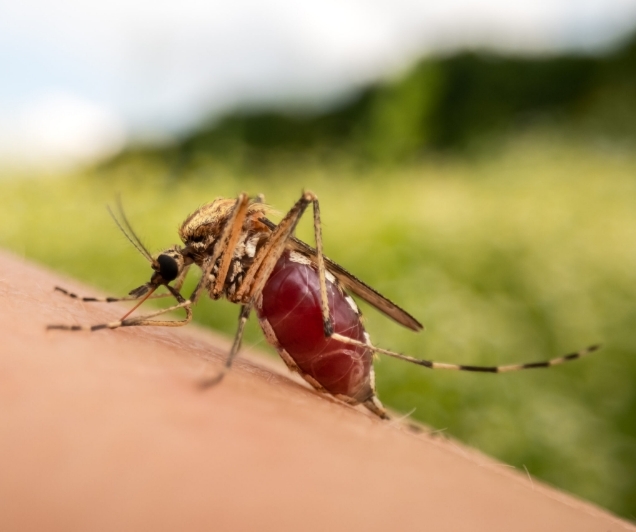
The mosquito that dominates a Montclair yard is the day-biting Asian tiger mosquito, and it breeds in containers, not wetlands. A clogged gutter, a plant saucer, a birdbath, a recycling bin, a tarp with a sag in it, each holds enough water to raise a batch in about a week, and a dense Montclair block has dozens of those small sources packed close together. When homes sit near one another, a mosquito born in one neglected yard bites the whole cluster of houses around it within days.
The mature street-tree canopy that makes Montclair leafy plays into it too. Shaded, humid ground under dense plantings and along fence lines is where adult mosquitoes rest through the heat of the day, and an older, tree-covered town gives them plenty of that resting cover. So Montclair stacks container breeding on close-set lots under a canopy that shelters the adults, which is the combination that keeps the biting up.
The daytime biter here is almost always the Asian tiger mosquito, an invasive, black-and-white striped species that feeds during the day, stays low, and rarely leaves the yard it hatched in. That backyard habit is the good news for treatment, because knocking out the local breeding and resting sites cuts the biting where you spend time.
The disease concern is West Nile virus, and it matters more in a county like Essex. West Nile is carried mainly by Culex mosquitoes, and the urbanized northeast New Jersey counties, Essex among them, are where activity tends to run higher. It builds through the second half of summer and peaks from the middle of August into September. Most people exposed never feel ill, but the virus can cause serious illness in some cases, so driving the mosquito population down around your home through that late-summer stretch is a real safeguard. Our program targets both the day-biting tiger mosquitoes and the Culex mosquitoes that carry the virus.

Cutting mosquitoes starts with cutting the water they breed in, and in a dense town most of that water is small and close. On a Montclair lot we look for clogged and sagging gutters, corrugated drain pipe, tarps and bin lids, plant saucers, buckets, birdbaths, and the low spots that stay wet after rain. On a tight block, the neighbor’s containers matter too, because a mosquito born two yards over bites yours, which is why treating the resting sites is as important as clearing the water.
We treat the daytime resting sites where adult mosquitoes shelter, the shaded undersides of shrubs, dense ground cover, fence lines, and the shady lower foliage under Montclair’s tree canopy. That resting-site work is where the treatment earns its keep in a leafy, close-set town, because it takes down the adults that drift in off neighboring lots as well as the ones you bred yourself.
Mosquito season in Montclair runs from late spring into the fall, and it climbs as the summer goes. The first biters appear as spring rain fills the containers and low spots around close-set homes. Numbers rise through June and hold hard through the humid depth of summer, when warm nights and standing water let generations overlap on a tight block. Then, from the middle of August into September, the West Nile picture moves to center stage, because that is when Culex activity in a county like Essex tends to run highest.
Because the pressure shifts across the season, a single treatment does not hold. We schedule recurring service so your protection carries through each phase, from the first spring hatch to the late-summer virus window and on until the cold shuts the mosquitoes down.
We have run mosquito control across the Northeast for more than 30 years, with over 2,400 five-star reviews and BBB accreditation behind us. A dense, tree-covered inner-ring town behaves differently from an open suburb, and our plans reflect that: we treat the source, the container water and the shaded resting sites, rather than misting the open lawn, so the results actually last through a Montclair summer.
The same wooded, shaded edges that shelter mosquitoes on the ridge side of town also hold ticks, so many neighbors run both together. See our tick control in Montclair, or start from the full Montclair pest control plan.

Every mosquito problem traces back to a source, and our work is to find yours and shut it down. We often pair mosquito treatment with tick and flea protection, since the wooded ridge-side edges of Montclair harbor ticks close to a lot of yards.
The work runs on a seasonal plan of six applications, from 79 to 99 dollars a month by property size, and it is backed by the Aspenn Protection Assurance: if mosquitoes flare up between treatments, we come back for a complimentary evaluation and re-treat at no extra charge.
Tell us where the biting is worst and we will build the plan around your lot and the season.
Density. The day-biting Asian tiger mosquito breeds in container water, and a close-set Montclair block has dozens of small sources packed together, so a mosquito bred in one yard bites the cluster of homes around it. The mature tree canopy adds shaded resting cover for the adults.
Yes, and that daytime biter is usually the Asian tiger mosquito, an invasive species common across inner-ring New Jersey. It feeds during the day, stays low, and rarely leaves the yard it hatched in, which is why treating your own property works so well against it.
It is worth taking seriously here. West Nile is carried by Culex mosquitoes, and the urbanized Essex County area sees real activity, which peaks from mid-August into September. Most people never get sick, but reducing mosquitoes around your home during that window lowers the risk.
Yes. On a tight Montclair block a mosquito bred two yards over will still bite you, so besides clearing the water on your own lot, we treat the shaded resting sites where those drifting adults shelter. That is how we hold results even when a neighbor’s yard is breeding them.
A treatment keeps working for several weeks, but mosquito pressure rebuilds as new generations hatch, so recurring service through the season holds far better than a single visit. Our plan runs six seasonal applications matched to Montclair’s season.
Yes. Tell us your date and we will schedule a treatment to knock the population down beforehand. If a hot, wet spell suddenly swarms the yard, reach out and we will prioritize getting to you.
Empty and refresh anything holding water at least weekly, including birdbaths, saucers, buckets, bin lids, and tarps, and keep gutters clear. That removes the backyard nurseries. Our treatment then handles the resting sites and the pressure drifting in from close-by lots.
We treat the whole township, from Upper Montclair and the estate sections to the dense downtown districts. If you do not see your area named, just call. We are already working Montclair.