
The species behind most of the misery in Delaware’s coastal towns is Aedes sollicitans, the eastern salt marsh mosquito. Females lay eggs on damp soil at the upper edges of grassy tidal marsh. Those eggs sit and wait, sometimes for a long time, until a high tide or a heavy rain floods the depression and triggers a hatch.
From there it moves fast. Adults can emerge in as little as four to five days after the eggs hatch, and they emerge together in enormous numbers. Young females then disperse inland at roughly a mile a day, with a brood typically moving less than five miles from the coast before heading back. If your house sits inside that band, you are downwind of a nursery you cannot see, and nothing you do to your own yard changes when the next brood arrives.
What This Explains About Your Yard
If you have ever emptied every saucer and birdbath on the property, cleaned the gutters, and still been driven indoors at dusk, this is why. The advice written for suburban backyard mosquitoes is aimed at a different animal with a different life cycle.
What follows is how the tidal breeding cycle actually works and why it produces waves rather than a steady trickle, why the timing tracks the tide chart and the rain more closely than the calendar, why evenings are so much worse than mornings, what state marsh programmes do and where their remit stops, and what actually helps at the level of an individual property.
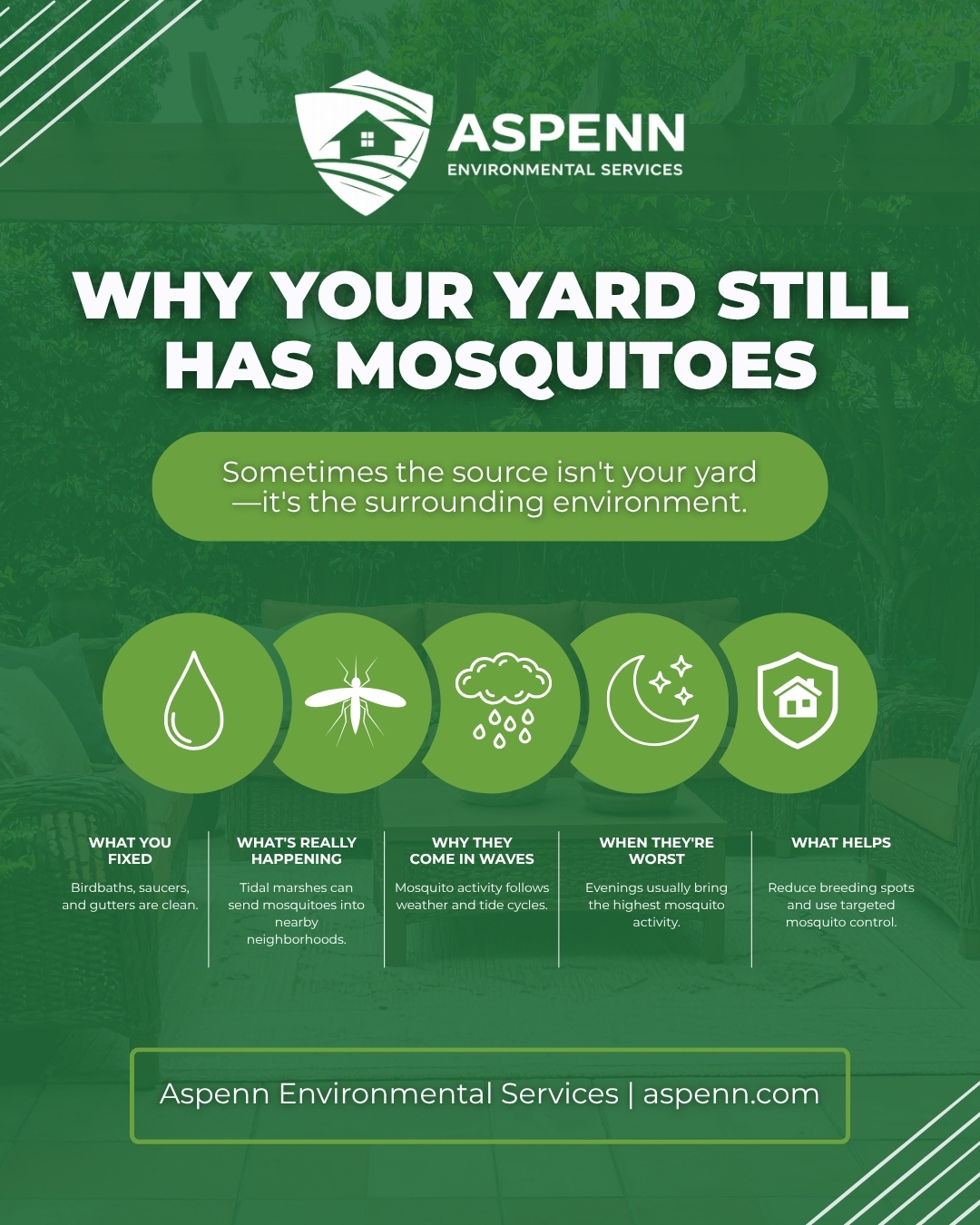
Salt Marsh Mosquitoes Breed On The Marsh, Not On Your Property
Most mosquito guidance starts with standing water on your property, and for container-breeding species that guidance is right. Salt marsh mosquitoes work differently.
Females deposit eggs individually on moist substrate around depressions at the upper reaches of grassy salt marsh. That is not open water. It is damp ground above the normal waterline, which is precisely why it is invisible as a mosquito problem and why nobody thinks of it as breeding habitat.
The eggs then wait for flooding. A spring tide, a storm surge, or a heavy rain pushes water into those upper depressions, the eggs hatch, and larvae develop in the temporary pools that result. Because the trigger is a flooding event rather than a season, the population arrives in pulses tied to tides and weather.
The species is adaptable about location too. Beyond the marsh itself, it colonises human-made sites including dredged material disposal areas and wastewater processing facilities, which means the nearest source is not always the obvious stretch of marsh on the map.
Why It Arrives All At Once
The speed is what makes this feel so sudden. Adults can emerge in as little as four to five days following egg hatch.
Consider what that means in practice. A big tide floods the marsh on a Saturday. By the middle of the following week, a brood is on the wing. It did not build gradually, so there is no warning period during which you notice mosquitoes getting worse and decide to do something. You get a normal evening, then an unbearable one.
This is also why the “what changed?” question usually has no answer at the property level. Homeowners look for a new source, a neighbour’s pond, a clogged drain, a boat cover holding water. Often nothing on the property changed at all. The tide changed.
How Far They Travel, And Why That Puts You In Range
The dispersal behaviour is the part that surprises people most, because it puts houses well away from any visible marsh squarely in the flight path.
Young females travel about one mile a day while dispersing, and the average distance a brood moves inland before returning to the coast is generally less than five miles. Five miles covers a great deal of Sussex County. A house in Lewes, Rehoboth, Dewey, Bethany or Fenwick Island can be nowhere near marsh by eye and still sit comfortably inside the range of several breeding areas.
Behaviour shifts after egg-laying, which is a useful detail. Once females have laid, they tend to remain much closer to the marshes rather than continuing to push inland. So the mosquitoes reaching an inland yard are disproportionately young, host-seeking females at the dispersal stage of their lives, which is exactly the group looking for a blood meal. Every female needs a blood meal for each batch of eggs she produces.
They feed primarily on mammals, with birds secondary, and they will readily attack during daylight when a host enters their territory. That last point matters for anyone walking a dog along a marsh edge or working in a yard that backs onto one, where daytime biting is common even though the main activity period is later. The same edges are where ticks concentrate, so coastal properties often have both problems in the same strip of vegetation.
Why Evenings Are So Much Worse
Host-seeking happens mainly during twilight, and more in the evening than in the morning.
That asymmetry is worth planning around, because it is consistent. Morning coffee on the deck is a very different proposition from an evening one during a brood, and families often conclude the yard is unusable when in fact it is unusable for a couple of hours around dusk. Shifting an outdoor dinner earlier, or moving it under a fan on a screened porch, recovers a lot of the summer.
Seasonally, northern populations of this species peak in summer while southern populations peak in spring and autumn. Delaware sits in the transition between those patterns, which is part of why coastal pressure here can feel less predictable than a simple summer curve.
It also means the season runs longer than most visitors expect. Renters who come for a week in July form an impression of coastal mosquitoes that has little to do with what year-round residents deal with in September and October, when a warm autumn and a run of high tides can produce pressure as bad as anything in midsummer. Homeowners who shut down their treatment programme after Labor Day on the assumption that mosquito season ends with the beach season are frequently caught out by exactly that.
What The State Does, And Where It Stops
Delaware runs an active mosquito control programme that treats tidal marsh habitat, and it is genuinely substantial work at a regional scale. Understanding its remit is the key to setting expectations for your own property.
State-level marsh work targets larvae in the breeding habitat across large acreages of tidal wetland. That reduces how many adults emerge overall. What it cannot do is guarantee that a given brood does not reach a given street on a given evening, because the programme operates on the marsh, at a scale measured in acres and impoundments, not on individual yards several miles inland.
So the two efforts address different parts of the same problem. Marsh treatment reduces production at the source. Property-level work addresses the adults that arrive anyway, resting in the shaded, humid vegetation around a house between feeding periods.
Neither replaces the other, and anyone promising that a yard treatment will make a coastal property mosquito-free during a brood is overselling. That is not how a five-mile dispersal works.
What Actually Helps At The Property Level
Given all of the above, here is a realistic view of what moves the needle around a coastal home.
Adult resting habitat is the useful target. Between feeding periods, mosquitoes rest in cool, shaded, humid places: the underside of dense shrubs, ivy and pachysandra beds, tall grass at the property edge, under decks, behind sheds. Thinning dense plantings, keeping edges cut, and improving air movement in those pockets makes a property less hospitable to the adults that arrive.
Barrier applications to that resting vegetation are the standard approach for adults on a property, and timing matters more here than on an inland property. Because pressure arrives in pulses, service that tracks tide and weather patterns through the season is more useful than a rigid calendar interval. This is the argument for a local company that watches coastal conditions rather than running the same schedule it would use in an inland suburb.
Personal and structural measures still earn their place. Repair window and door screens, since a house full of mosquitoes during a brood usually has a screen problem rather than a yard problem. Use fans on porches, because these are not strong fliers against moving air. Reserve the yard for earlier evening hours during peak weeks.
Emptying containers remains worth doing, and it will help against the container-breeding species that also live in the area. Just do not expect it to change salt marsh mosquito pressure, because that population never used your containers.
How To Read Your Own Property
A few minutes of observation tells you more about a coastal property than any general guidance can, because sites a few streets apart can behave quite differently.
Start with the direction the pressure comes from. Stand outside at dusk during a bad week and notice which side of the house is worse. Coastal properties usually have a windward and a leeward story, and the sheltered side, where air stalls against a fence line or a hedge, is where adults concentrate. That is the side worth thinning and treating hardest, and often it is not the side people assume.
Then look at your own boundary planting. Dense evergreen hedging, ivy running up a fence, ornamental grasses left uncut, and the shaded gap between a shed and a boundary wall are all resting habitat. None of them breed mosquitoes, which is why they get overlooked, but they decide how many of the arrivals stay on your property rather than moving through it.
Watch the tide chart alongside the forecast, at least for a season. Homeowners who start doing this are usually surprised how well the bad weeks line up with the highest tides of the month and the rain events that follow them. Once you can anticipate a brood by a few days, you can plan around it, which is a real quality-of-life gain even before any treatment.
Finally, be realistic about what a neighbouring property can undo. Mosquito pressure does not respect a lot line, and a well-managed yard next to an untended one with heavy overgrowth will carry some of the neighbour’s burden. On streets where several houses back onto the same marsh edge, a coordinated approach among neighbours does noticeably better than one household working alone.
Aspenn works across Delaware’s coastal towns as well as New Jersey, and the wider Northeast, and coastal properties get treated with the tidal cycle in mind rather than a generic suburban schedule.
One thing to take away
The single most useful shift is to stop thinking of this as a yard problem. Salt marsh mosquitoes are produced on tidal wetlands, hatch on the schedule of tides and storms rather than the calendar, emerge together in days, and travel inland far enough to cover most of the Delaware beach communities. That is why the pressure changes overnight, why your neighbour’s habits are not to blame, and why the useful response is a mix of reducing resting habitat around the house and treating on a rhythm that follows coastal conditions. If evenings on your property have become unusable during brood weeks, Aspenn Environmental Services can look at how your specific site sits relative to the marsh and what a realistic treatment rhythm looks like for it.