
When a patch of North Brunswick lawn turns brown in late summer and pulls up like a loose rug, the problem is usually not drought and not disease. It is grubs, the white, C-shaped beetle larvae feeding on the grass roots underneath. We are Aspenn Environmental Services, based right here in town, and grub control comes down to one thing above all others: timing. Treat at the right point in the season, and you stop the damage before it starts. Miss the window, and you are patching dead turf in September.
The other tell is the digging. Skunks, raccoons, and moles hunt grubs, and if something is tearing up your lawn overnight or you can peel back the sod to find fat white larvae curled in the soil, you have a grub population worth treating. We build the plan around the North Brunswick season and the grub species actually working local lawns.
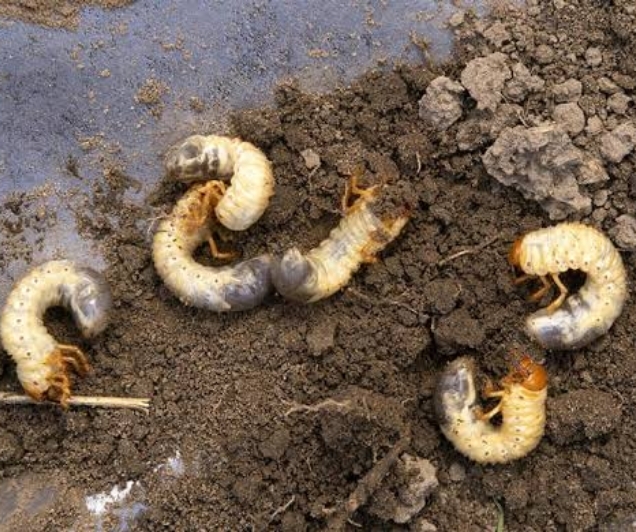
Grubs live in the soil and eat grass roots, and that is what makes them so destructive. A healthy lawn holds together because its roots knit into the ground. When grubs sever those roots, whole sections lose their anchor, so the turf browns out even with plenty of water and lifts away in sheets when you tug it. The damage tends to show as irregular brown patches that spread through late summer and into fall.
The second wave of damage comes from above. Skunks, raccoons, crows, and moles all dig for grubs as a food source, and a heavy population can turn a smooth lawn into a torn-up mess in a few nights as the wildlife roots around for the larvae. So a grub problem often costs you the lawn twice, once from the feeding below and once from the digging on top. Both stop when the grub population is brought down.
Several beetle species produce the white grubs that damage New Jersey lawns, and they matter because their timing and their weak points differ. In this part of the state the oriental beetle has become the most common turf grub, alongside the Asiatic garden beetle, the northern masked chafer, and the familiar Japanese beetle whose adults chew ornamental leaves before their larvae go after roots.
They share a yearly rhythm. The adult beetles are active and lay their eggs in the lawn through the early summer, roughly June into July. Those eggs hatch into small grubs that feed close to the surface through late summer, growing as they eat, which is exactly when the root damage and the brown patches appear. As the grubs get larger and the soil cools, they burrow deeper for winter, then return toward the surface briefly in spring. Knowing which species dominate a lawn helps, since some, like the masked chafer, shrug off certain products that work well on others.

Grubs go after sunny, open turf, which is the opposite of where ticks hide, so the lawns most at risk here are the wide, well-kept front and back yards across town rather than the shaded wooded edges. Beetles prefer to lay eggs in sunny, irrigated grass, so a lush, watered North Brunswick lawn can actually draw more egg-laying than a patchy one. Newer developments with fresh sod and open lots, and any home that waters through the summer, sit squarely in the target zone.
History is the other risk factor. A lawn that had grubs or nighttime digging last year is likely to see them again, because the beetles return to the same favorable turf. If your neighbor is fighting skunk damage, your lawn is probably on the same beetles’ route. We factor last season into this season’s plan, since grubs are a repeating problem, not a one-time accident.
Grub control succeeds or fails on the calendar, so here is how we read the North Brunswick season.
The prevention window is late June through mid-July. That is when the beetles are laying eggs and the new grubs are tiny and near the surface, which is the point where a preventive treatment does the most with the least. A key detail: the product has to be watered in, so it moves down through the thatch to where the grubs are. A treatment that sits dry on top does little.
By late August into September, the grubs are large, hungry, and harder to reach, and this is when most homeowners first notice the damage. Treatment is still possible at that stage, but it is a rescue rather than prevention, and the results are less certain than hitting the early window. Once the soil cools and the grubs dig deep for winter, treatment stops making sense until the next cycle. The honest takeaway: the best time to deal with grubs in North Brunswick is before you can see them.
We have cared for North Brunswick lawns for more than 30 years, so we know the local grub timing without guessing, and timing is the whole ballgame with grubs. We treat in the early-summer window when it counts, we water the product in, and we watch the species that shrug off the wrong treatment. That is the difference between a green lawn in September and a peeling brown one.
We are BBB accredited, we have earned thousands of reviews across our service area, and we are based right here in town, so we are already on your streets through the season. Grubs travel with the other yard and perimeter pests we handle, and the same lawns often send ants toward the house, so many neighbors bundle the two. Pair this with ant control in North Brunswick, or start from the full North Brunswick pest control plan.

Our plan is built around prevention first. We time the treatment to the early-summer egg-lay and the young-grub stage, we water it in so it reaches the root zone where the grubs feed, and we account for the species mix on your lawn. Where damage has already started, we assess whether a late-season treatment still helps and are straight with you about what it can and cannot recover.
Tell us what your lawn is doing and we will time the treatment to beat the damage.
Look for irregular brown patches in late summer that stay brown despite watering, and try to pull the turf up. If it lifts like a loose carpet because the roots are gone, and you find white C-shaped larvae in the soil, grubs are the cause. Nighttime digging by skunks or raccoons is another strong sign.
The prevention window is late June through mid-July, when the beetles are laying eggs and the new grubs are small and near the surface. Treating then, and watering the product in, is far more reliable than waiting until damage shows in late August or September.
Skunks, raccoons, crows, and moles dig for grubs as a food source. If the digging shows up in late summer and you find grubs when you check the soil, the wildlife is after them. Bringing the grub population down removes the reason they keep tearing up the turf.
Sometimes, but it is a rescue, not prevention. A late-season treatment can stop further feeding, though damaged turf may still need reseeding or sod, and the results are less certain than treating in the early window. We will look at the damage and tell you honestly what to expect.
Not every lawn does, but sunny, watered North Brunswick lawns are prime egg-laying turf, and beetles move in from nearby yards. If a neighbor had grubs or skunk digging, your risk is higher. We help you weigh whether prevention makes sense for your specific lawn.
The product has to move down through the thatch to the root zone where the young grubs feed. Watering it in carries it to that layer. A treatment left dry on the surface never reaches the grubs, which is a common reason do-it-yourself grub control fails.
No. Several beetle species cause white grubs here, including the oriental beetle, Asiatic garden beetle, northern masked chafer, and Japanese beetle, and some resist products that work on the others. We account for the species mix and the timing rather than applying one blanket approach.
We treat lawns across the whole town, from Adams and Franklin Park to Livingston Park, Maple Meade, and Red Lion, including the newer developments with open, irrigated turf. If you do not see your street named, just call. We are based right here.