
An ant problem on a Short Hills estate is usually a moisture problem, and the moisture usually comes off the woods. A home sitting against the South Mountain treeline lives in the reservation’s damp shade, and the irrigation, the mature plantings, and the extensive stone hardscape of a high-end property hold that damp right against the foundation, which is exactly the condition several ant species need to nest. We are Aspenn Environmental Services, and we treat ants by finding the nest and working the perimeter, not by wiping the same trail off the counter every morning.
Damp decides where ants settle, and an estate home against the South Mountain woods has more of it than the owner tends to notice. The tree cover shades the ground so it never fully dries, the reservation holds humidity along the property line, and a large landscaped lot layers on its own moisture: irrigation running through deep beds, mulch banked against the house, downspouts feeding planted borders, and the stone walls, patios, and walkways of a big hardscape trapping damp underneath. Every one of those is a place a colony can nest.
The scale of the property works against the homeowner too. A large estate home has a long foundation, multiple wings, additions and porches added over the years, and an extensive footprint of hardscape, which means many more seams, joints, and entry points than a compact house offers. Water and ways in, both in abundance, are what turn a reservation-side estate into good ant habitat, which is why the problem here is a story about the grounds and their moisture rather than about crumbs on the counter.
Because the treatment depends on the species, identifying which one you have comes first.
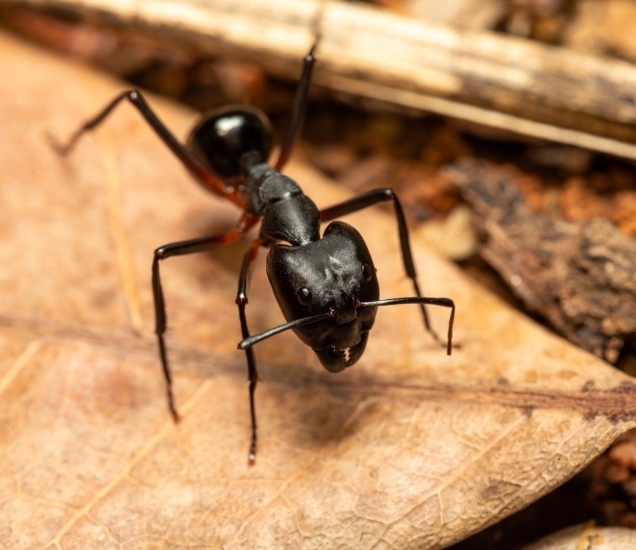
The large black ones are carpenter ants, and on a damp, wooded estate lot they lead the concerns. Wood is their nursery, not their food: they excavate galleries in wet or softened timber, so they surface at a damp sill, a leaking gutter line, the framing of a porch or wing that has taken on moisture, or trim shaded by the reservation canopy. Winged ones appearing indoors in spring mean the nest is already in the structure.
The tiny dark ones trailing to the kitchen are odorous house ants, named for the smell a crushed one gives off; their colonies grow fast and pour indoors after spring rain. The dark ants pushing little cones of soil up through the joints of a stone patio or walk are pavement ants, working the hardscape seams toward the house. Different nesting habits, different treatment for each.

We name the ant first, since a carpenter ant job and a pavement ant job call for different treatments.
We follow the trail to its nest and entry, working the foundation, the damp framing and sills, the door and window lines, the stone hardscape joints, and the seams where porches and wings meet the house.
We treat the colony and the exterior perimeter with methods chosen for the species, so the nest is handled, not just the workers on the counter.
We flag the moisture and wood defects feeding carpenter ants, which on a wooded estate lot is frequently the heart of the fight.
We set a spring-through-summer schedule, because the colonies return every warm season.
It turns in spring. The colony breaks dormancy, swells, and pushes foragers indoors while carpenter ant swarmers take wing, so a house quiet in February can show trails by April. Summer heat sustains it, and a wet spell drives the ants inward toward a dry floor or deeper into a damp basement. Because the colonies rebuild every warm season, a year-round perimeter program outlasts a single April spray, and across a big estate home with a long, seam-rich foundation that continuity earns its keep.
More than 30 years across the Northeast, over 2,400 five-star reviews, and BBB accreditation stand behind the work, and on a large estate property the perimeter read is what separates a fix that holds from one that fails. We know the difference between a reservation-side Millburn home nursing carpenter ants in a damp sill and a house with pavement ants under a stone patio, and we treat the actual species rather than guessing.
The same damp grounds that feed ants often push grubs into the lawn, so many neighbors take the two together. Pair this with grub control in Short Hills, or start from the full Short Hills pest control plan.

We start by tracing the trail back to the nest and the conditions keeping it there, then treat the colony and ring the exterior perimeter, which on a large estate home with a long foundation and extensive hardscape is most of the work. Where damp wood is the driver, as it usually is with carpenter ants on a wooded lot, we point out the leak, the wet sill, or the softened framing that has to be dried or repaired, because no product outlasts a wet nest.
The plan runs six seasonal applications, 79 to 99 dollars a month by property size, backed by the Aspenn Protection Assurance: a return visit and re-treatment at no extra charge if the ants come back between treatments.
Tell us where the trails are showing up and we will follow them back to the nest.
The ones you see are scouts from a colony nesting nearby, usually odorous house ants after sugar. Wiping the trail clears the scouts but leaves the nest, so they return. We locate and treat the colony and its entry point, which is what stops the trail for good.
Moisture. A home against the South Mountain treeline lives in damp shade, and irrigation, mature plantings, and stone hardscape hold that damp against a long foundation, giving several ant species exactly the wet conditions they need to nest, plus plenty of seams to enter through.
They are large and black. Big black ants indoors, winged swarmers in spring, or faint sawdust-like shavings near woodwork point to them, and a nearby leak or damp sill is the giveaway, since they nest in wet wood. Treat them promptly.
Spring is the biggest push, as colonies wake and swarmers appear, and summer keeps it high, with wet weather driving ants indoors and into damp basements. A plan that runs spring through summer beats a single early spray.
For carpenter ants, usually yes: the wet or damaged wood they nest in has to be dried or repaired, or they return. For pavement and odorous house ants, cutting food sources and sealing obvious gaps helps our treatment last longer.
Yes, under the Aspenn Protection Assurance. If ants return between scheduled treatments, we come back for a complimentary evaluation and re-treat if needed at no extra charge.
We apply to label and place product where ants travel, the perimeter, cracks, and nesting zones, rather than across open living space. Tell us about children, pets, and sensitivities and we plan around them.
We handle ants township-wide, from the Short Hills estate sections and the reservation edge to the Millburn neighborhoods. If your street is not named, just call. We are already working the township.