
Grubs behave differently on a shaded Montclair lot than on an open one. The beetles that lay them chase sunlight, so on a leafy property the eggs go into the one bright patch, usually the front strip, and that is where the white, C-shaped larvae end up chewing the roots. We are Aspenn Environmental Services, and here the whole game is the calendar: catch the early-summer window and there is no damage to fix; let it slip and you are repairing the most public square of a small lawn in September.
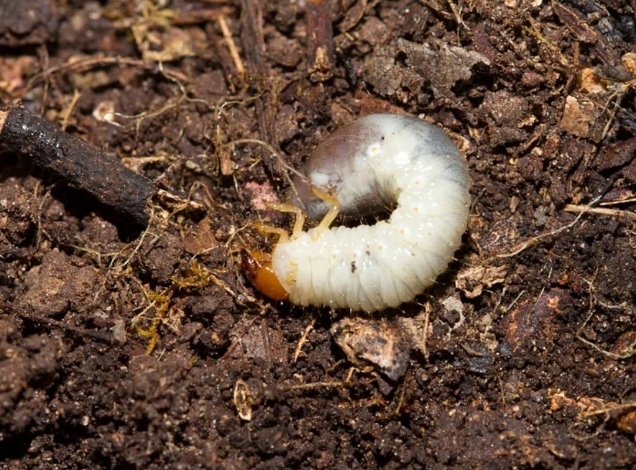
A shaded lot narrows the beetles’ options. They will only lay in grass that gets sun, so on a canopied Montclair property that means the front strip, a bright corner of the back, a sunlit curb edge, and little else. The grubs then pile up where the light does rather than fanning across the whole yard, which loads the damage onto the lawn’s most visible piece.
That is why a grub run reads worse in Montclair than the size of the lot implies. On a big lawn a peeling patch is a single ruined corner; on a small, sun-limited front lawn it is most of what the block can see. Shaded turf also mends slowly, because roots grown in low light are slower to rebuild once grubs have severed them, so getting ahead of it counts for more on these lots.
Underground first: the larvae live in the soil and cut the roots, so the grass loses its grip and browns off no matter how much you water it, then peels away in a sheet at a tug. On a compact Montclair lawn that turns visible in a hurry, because there is not much turf to spare.
Then overhead: skunks, raccoons, and crows come after the grubs, and even a built-up town has that wildlife prowling yards after dark, so a few nights of digging can leave a small front lawn cratered and shredded. The tearing usually raises the alarm before the homeowner spots the grubs themselves. Both problems settle once the population underneath is cut back.

The ones with genuine sun. A Montclair lot with an open, watered front lawn or a bright back patch is where the eggs go, so those are the grub magnets, not the shaded ground under the canopy. Track record is the other signal: turf that had grubs or overnight digging last year tends to draw them again, since beetles come back to what worked, and on a tight block a neighbor’s grub lawn is a heads-up for yours. Last season factors into the plan.
We lead with prevention aimed at the sunny ground the beetles use. The application is timed to the June-into-July laying and the young-grub stage, watered in to reach the roots, and fitted to the beetle mix on your turf. If damage has already begun, we look at it and say plainly whether a late pass still buys anything or whether the front strip needs reseeding, and we are upfront that a shaded lawn takes its time to fill back in.
Thirty-plus years on Northeast lawns, more than 2,400 five-star reviews, and BBB accreditation stand behind the work, and grubs are a timing job before anything else. We treat inside the window that matters, water it in, and account for the species that defeats the wrong product, which decides whether the front lawn is green in September or peeling where the whole street can see.
Grubs run with the other yard pests we handle, and the same lots tend to push ants into an old house, so many neighbors take the pair together. Add ant control in Montclair , or start from the full Montclair pest control plan.

A handful of beetles produce New Jersey’s lawn grubs, led locally by the oriental beetle and joined by the Japanese beetle, the Asiatic garden beetle, and the northern masked chafer. Their calendar is shared: the adults drop eggs into the turf across June and July, those eggs become surface-feeding grubs through the back half of summer, and the brown patches surface right as that feeding peaks.
Prevention has a tight window, late June to mid-July, while the grubs are shallow and young, and it only works if the material is watered in to carry it down to the roots; dry on top, it accomplishes almost nothing. Once late August arrives the grubs are large and deep and far harder to hit, which turns any treatment into a salvage job, and because the masked chafer shrugs off products that beat the others, we fit the treatment to what is actually in the lawn.
The plan is six seasonal applications, 79 to 99 dollars a month by property size, under the Aspenn Protection Assurance: trouble between visits brings us back to re-treat at no added cost.
Tell us what the lawn is doing and we will time the treatment to get ahead of the damage.
Late-summer brown patches that stay brown no matter how much you water are the first clue, most often in the sunny front strip. Tug the turf; if it rolls up like loose carpet with the roots gone and white C-shaped larvae underneath, it is grubs. Overnight digging by skunks or raccoons is the second clue.
Beetles lay in sun, and on a shaded Montclair lot the sunny front strip is usually the main open turf, so the grubs gather there. It also happens to be the most visible stretch, which is why a small patch looks worse than the lot size suggests.
Late June to mid-July, while the beetles are laying and the young grubs sit near the surface. Treating in that window and watering it in beats waiting for the damage to appear in late August or September.
Skunks, raccoons, and crows hunting grubs, and they work yards even in a built-up town. If it starts in late summer and there are grubs in the soil, they are the reason. Reducing the grub count removes the draw.
Sometimes, as a salvage rather than prevention. A late pass can halt further feeding, but a chewed strip may still need reseeding, and a shaded Montclair lawn recovers slowly, so early treatment matters more here. We look and give you the honest call.
It has to move through the thatch to the root zone where the young grubs feed, and water carries it there. Sitting dry on the surface it never arrives, which is why so much store-bought grub control disappoints.
Yes, under the Aspenn Protection Assurance. Trouble between scheduled treatments brings us back for a complimentary evaluation and a re-treatment if needed, at no extra charge.
We treat lawns across the township, from Upper Montclair and the estate sections to the downtown districts. If your street is not named, just call. We are already working Montclair.