
In Middletown, ants are usually a moisture story. The ants on your counter are scouts from a colony that settled somewhere damp nearby, and a bayshore township hands them more damp than most. We are Aspenn Environmental Services, and we treat ants by finding that nest and closing the perimeter it travels, not by wiping the same trail off the counter every morning.
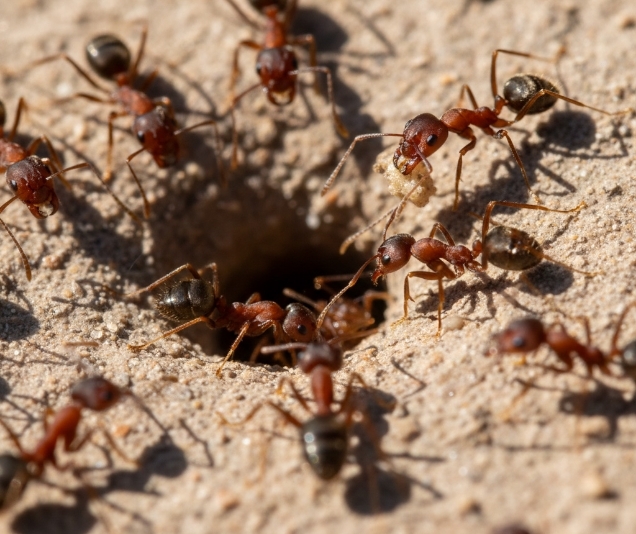
Water sits close to the surface across much of Middletown, and that is what the ants are after. The bayshore villages, Belford, Leonardo, Port Monmouth, and Navesink, run low and near Raritan and Sandy Hook Bays, where a high water table and steady salt-air damp keep crawl spaces, sill plates, and foundation wood wetter than an inland home would ever be. To a carpenter ant, damp framing is a housing listing.
That is the difference between Middletown and a drier town two exits inland. Here the moisture does half the work for the ants before they ever reach your kitchen. The interior lots add their own damp from shade and heavy plantings against the house, but it is the shore-side homes, especially the older ones, where we most often trace a stubborn ant problem back to wet wood rather than to crumbs on the counter.
The fix depends entirely on the species, so identifying it is the first thing we do.
The large black ants are carpenter ants, and on the damp bayshore they are the ones to take seriously. They do not eat wood, they tunnel moist or rotting wood to nest in it, so they show up around a leak, a soft window frame, a wet bathroom wall, or wood held against wet soil. Winged carpenter ants indoors in spring mean a nest inside the structure, not out in the yard.
The small dark ants trailing to anything sweet are odorous house ants, named for the smell they give off when crushed; they build fast, splinter into satellite nests, and pour indoors after spring rain. The dark ants pushing little soil piles up through driveway and slab cracks are pavement ants, working the foundation joints in for grease and sugar. Each nests differently, so each gets a different treatment.

We identify the ant, because a carpenter ant job and a pavement ant job are not the same treatment.
We follow the trail to the nest and the entry, checking slabs, foundation cracks, damp framing, window and door lines, and the perimeter where plantings meet the wall.
We treat the colony and the outside perimeter with methods matched to the species, so the whole nest is hit, not just the workers you can see.
We flag the moisture and wood problems feeding carpenter ants, which on a bayshore home is often the whole battle.
We set a schedule across spring and summer, since the colonies come back every warm season.
Spring is the turn. Colonies come out of winter, grow fast, and throw scouts across the kitchen, and carpenter ant swarmers pick this stretch to appear, which is why a February-quiet house can be trailing by April. Summer holds the pressure up, and a wet spell, or a coastal storm driving damp into the bayshore homes, tends to push ants indoors looking for dry ground. Because the colonies rebuild every warm season, a perimeter plan that carries across the year holds where a single April spray does not.
More than 30 years across the Northeast, over 2,400 five-star reviews, and BBB accreditation back the work, and on Middletown the moisture read is what separates a fix that holds from one that fails. We know the difference between a damp Port Monmouth home nursing carpenter ants in wet framing and a Lincroft lot with pavement ants under the drive, and we treat the actual species rather than guessing.
The same yards that feed ants tend to feed the grubs chewing the turf, so many neighbors take the two together. Pair this with grub control in Middletown, or start from the full Middletown pest control plan.

We start by tracing the trail to the nest and the conditions keeping it there, then treat the colony and ring the exterior so fresh scouts cannot simply reopen the line. On the shore side, where wet wood is usually the real driver, we will point out the leak or the damp framing that has to be dried or repaired, because no product outlasts a wet nest.
The plan runs six seasonal applications, 79 to 99 dollars a month by property size, backed by the Aspenn Protection Assurance: a return visit and re-treatment at no extra charge if the ants come back between treatments.
Tell us where the trails are showing up and we will follow them back to the nest.
The ones you see are scouts from a colony nesting nearby, usually odorous house ants after sugar. Wiping the trail clears the scouts but leaves the nest, so they return. We locate and treat the colony and its entry point, which is what stops the trail for good.
Moisture. The bayshore villages sit low near the water with a high water table and salt-air damp that keep foundations and framing wet, and several ants, carpenter ants above all, need that moisture to nest. Damp shore homes give them a running start.
They are large and black. Big black ants indoors, winged swarmers in spring, or faint sawdust-like shavings near woodwork point to them, and a nearby leak or damp frame is the giveaway, since they nest in wet wood. Treat them promptly.
Spring is the biggest push, as colonies wake and swarmers appear, and summer keeps it high, with wet weather and coastal storms driving ants indoors. A plan that runs spring through summer beats a single early spray.
For carpenter ants, usually yes: the wet or damaged wood they nest in has to be dried or repaired, or they return. For pavement and odorous house ants, cutting food sources and sealing obvious gaps helps our treatment last longer.
Yes, under the Aspenn Protection Assurance. If ants return between scheduled treatments, we come back for a complimentary evaluation and re-treat if needed at no extra charge.
We apply to label and place product where ants travel, the perimeter, cracks, and nesting zones, rather than across open living space. Tell us about children, pets, and sensitivities and we plan around them.
We handle ants township-wide, from the damp bayshore villages to Lincroft and the interior. If your street is not named, just call. We are already working Middletown.